Showing posts with label Tudor. Show all posts

Thursday, December 30, 2010

I'm Moving!!!


Ok, I'm not exactly moving, The Tudor Blog is moving.
For 2011 I have decided to venture out to a new address and make this blog a far more dynamic site.

Please join me at my new digs:
www.TheTudorBlog.com

The new site is a work in progress, so I will keep this one live for a little while too.
C'mon over and let me know what you think of the new place.
(Sitewarming gifts are welcome ;-)

Hilarious History Lessons


Browsing The Washington Post this morning, I found an article on a hilarious You Tube Channel that uses music to teach history lessons. The History Teachers' Channel uses a combination of songs from old and new artists and video clips from famous movies on the topics cut together with live action video of actors singing a song parody. It’s pretty funny, although some desperately need to be redone and made modern.

Click here to see hits like

* The French Revolution set to Lady Gaga’s Bad Romance
* Cleopatra taught to Fergalicious
* The Black Death is done with Hollaback Girl by Gwen Stefani

The bummer is that the Tudor videos are all older with songs that kids today will NOT know.

* Anne Boleyn is put to “Girl” by the Beatles (and very hokey with the dancing girl in an odd headdress.)
* Henry VIII is set to an ABBA song I’ve never heard
* Elizabeth I is done with She’s Not There by The Zombies
* Mary Queen of Scots to Jenny from the Block by JLo

They’re entertaining, but I do think they should update them because kids will be more interested and learn better if it’s music they can relate to!

Tuesday, December 28, 2010

Cook Like a Tudor

Stuffed swans, blackbirds baked in a pie or roasted haunch of venison all would have had a place on Henry VIII's royal menu around this time of year, with special culinary variations for Christmas and New Year.

Now you can see exactly what the Tudors ate at the recently restored kitchens in Hampton Court Palace. The historic royal palace is offering free online cooking lessons, recipes, and historical tidbits about the 500-year-old cuisine.

Three of Henry’s favorite dishes are featured: ryschewys close and fryez (sweet and spicy Christmas dumplings), tarte owt of Lente (a rich cheese pie) and fylettys en galentyne (roast pork in caramelized onion gravy). Chef Robin Mitchener is the video guide to the Tudor palette.

If you're lucky enough to live in or be visiting London, Hampton Court Palace is offering in-person Tudor cooking demonstrations until Jan. 2. Visitors can watch chefs at work on the king’s Christmas feast. The demonstrations are included in the palace's general admission, which is about $24 per adult at the door.

Saturday, December 25, 2010

I Stand Corrected, Kind of...


One of my most redeeming qualities is my ability to admit when I am wrong.

In this post about Alison Weir's book The Lady in the Tower: The Fall of Anne Boleyn I stated that "I knew I wouldn't like this book."
As it turns out, I liked this book very much.

Admittedly, I need to read it a second time in order to fully understand some of Weir's assertions about whether or not Anne was guilty of "some" crimes which may have lead to her enemies getting a foothold in the case against her. I have been having a good conversation with a reader named Sarah about Weir's meaning and I am open to the idea that I misunderstood what Weir was driving at.

But this post is about the second half of this book. I LOVED it. What Alison Weir was able to do, unlike other historians or biographers, was to capture Anne's possible feelings and moods in her final hours of this life. I attribute this to the author being a woman. Although it has been almost 5 years since I read Eric Ives' book The Life and Death of Anne Boleyn, I recall vividly that it felt very forensic at times. That's not to say that it's a bad thing to present her life in that manner, but it was incredibly refreshing to read someone's take on everything from her possible emotions about her impending doom to the potential for pain and lingering thoughts at the time of beheading.

I also enjoyed the final chapter of the book where Weir recounts some of the legends and ghost stories surrounding Anne Boleyn.

All in all, a good read and different enough from all the others to make it worthy of your bookshelf or a place in your eReader's memory.

Friday, November 26, 2010

Pick a View and Stick to it!

As any full-time or amateur historian will tell you, pinpointing the dates of events in Tudor history is a very frustrating proposition.

Besides the fact that we are missing simple information, like birth dates for many--especially women--born between 1480 and 1603, a great deal of information has been lost over the centuries to fires and other disasters. This is not even to mention the many during the reign of Elizabeth I (and later Victorians) who tried to vindicate those beloved by their sovereign or create history where they found none.

As I read Alison Weir's latest, The Lady in the Tower: The Fall of Anne Boleyn, I am frustrated by the amount of speculation required to piece together events. To a degree, I suppose that historians are happy that there are such holes in story's fabric, as new speculations sell books.

I avoided this book at first, as other reviewers pointed out what I have now read for myself: Weir's conclusion is that Anne Boleyn--while perhaps not guilty of the laundry list of offenses on which she was indicted--was guilty of something, and thus made her own bed.

What was not stated by reviewers was that a chapter or two later, Weir writes the sentence, "In a word, Anne Boleyn was framed."

This is where I begin to be angry and confused by Tudor historians. I may not agree with your theory, but I can only respect it if you choose one and stick with it!
I am not a fan of those who publicize one stance to get me to buy a book, but then hedge their bets.

I have already decided to go back and read those chapters again. Perhaps it's me and I misunderstood her meaning.

It's funny, I knew I wouldn't like this book--but was way of on the reason why.

Tuesday, November 16, 2010

The Kate & Wills Tudor Connection!


Paging through all the Prince William, Kate Middleton engagement coverage today, I stumbled upon an article that connects them to the Tudors!


I guess it shouldn't be that shocking considering the royal family is related to just about all the

royal families in European history. In fact, William and Kate are even related to each other. They are 12th cousins. Considerable separation for a royal couple.


The relative who connects the royal couple is actually a tyrant from the Elizabethan Era named Sir Thomas Leighton. According to the Daily Mail Online:

'In 1587 Leighton sailed to England to advise Sir Walter Raleigh on defence. In gratitude, the Queen gave him a knighthood, and her cousin Elizabeth Knollys' hand in marriage'


The article focuses on Leighton's terrible rule as governor of Guernsey, but take note of who he married: Elizabeth Knollys.

Elizabeth Knollys was the Queen's cousin, and a relation of Anne Boleyn through her sister. Elizabeth Knollys was the granddaughter of Mary Boleyn through her daughter, Catherine Carey. The other interesting thing is that Catherine Carey has, for many years, been the subject of speculation about her patern

ity. Catherine was conceived during the time that her mother, Mary, was Henry VIII's acknowledged mistress. Although the king never claimed paternity of Catherine or even her brother, Henry.


So, we know for sure that Kate and Wills are related to Anne Boleyn, but perhaps they are related to Henry VIII as well!


Below is the lineage of Kate and William back to the last Tudor monarch.

Sunday, November 14, 2010

What REALLY Happened On This Day—November 14th—in Tudor History?

One of the more interesting claims to come out of the differing biographies and historical accounts of the Tudor Era is the possibility that Henry VIII and Anne Boleyn had more than one secret wedding ceremony and the anniversary of their ill-fated marriage is actually today, November 14, 1532.
Thanks to Elizabeth I's September 7, 1533 birthday, it's hard to dispute that Henry and Anne finally consummated their six-and-a-half-year relationship in November of 1532.
According to “The Life and Death of Anne Boleyn,” Boleyn biographer Eric Ives claims Henry and Anne thought that he was sufficiently detached from Katherine of Aragon to finally have sexual relations. After all, Henry just had taken Anne on the state visit to Calais to treat with King Francis I and even he officially received her as the King of England's consort--a major coup. There are also theories (as portrayed on Showtime's The Tudors) that Henry and Anne finally slept together when their return home was delayed by storms and they remained in Calais a few days.
The idea that a 16th century king desperate for a male heir would risk any resulting child being declared illegitimate is the likely impetus for the idea that Henry and Anne would marry--perhaps in secret--as quickly as possibly after the consummation. That would mean a November ceremony or perhaps just a traditional, formal betrothal.
By January, 1553, it's clear that Anne believed herself to be pregnant and it is widely believed the couple underwent a more formal secret ceremony in front of only their closest confidents on January 25 in the turret over the entrance gate to Whitehall Palace, London. In fact, the wedding was kept so quiet that Eric Ives quotes Eustace Chapuys, the Imperial ambassador, as reporting, in March 1533, rumors that Henry would not marry Anne until Easter of that year, clearly in the dark about any earlier wedding.
According to Ives's research, Tudor chronicler, Edward Hall, was the one who wrote of the possible November ceremony, putting forward St. Erkenwald's Day (November 14, 1532) as the date.
“The king, after his return [from Calais] married privily the Lady Anne Bulleyn on Saint Erkenwald’s Day, which marriage was kept so secret that very few knew it, till she was great with child, at Easter after.”
Of course, this date meant that Elizabeth was conceived in marriage. Had the wedding been January 25, Elizabeth would have been blatantly illegitimate by any standards. There would be no defense of her bastardy.
Even Catholic apologist and Boleyn hater, Nicholas Sander, dates Henry and Anne’s marriage as the 14th November.
All of this is fairly convincing evidence of two ceremonies.
Henry VIII loved nothing more than the masque. He loved to fool people and make them believe what he wanted them to believe. It is entirely possible that he would hold a secret wedding ceremony and dissemble in public.
However, the January ceremony baffles me a bit because Henry HAD to realize that the date would put paternity of his child (and long-awaited male heir, in HIS mind) and the legitimacy in question. They clearly had to real witnesses to a November ceremony and perhaps thought they needed another ceremony--with witnesses--to make it official before Anne started showing?
Then again, there seems to be no end to the things that baffle me (and millions of others) about Anne and Henry.

Wednesday, November 10, 2010

The Tudors' Jewelry Maker on Ideeli


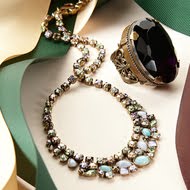
The jewelry maker who replicated some of the jewelry from the Showtime series The Tudors for retail (and I believe even made some pieces used on the show) is a featured brand this week on Ideeli. Sorelli has quite a few pieces that work with modern fashion and with your Renaissance/Tudor-centric costumes.

For those who don't know, Ideeli is a pretty cool little online sale site that keeps things fresh by only selling a small lot from a particular brand for a very limited time. They sell out VERY quickly... so if interested, I suggest going there now!

Check it out at www.ideeli.com

The Sorelli pieces just went on sale this morning (Nov. 10, Eastern Standard Time, USA).

Thursday, February 18, 2010

Creation of the Tudor Dynasty

I have been following this story for a few months now and was so excited to get an alert from The Times - UK today. We finally know the location of the Battle of Bosworth.
In Biblical terms: they found Garden of Eden.
On the morning of August 22, 1485, the last medieval king of England gambled his throne and his life on one desperate cavalry charge. Richard III lost everything to Henry Tudor (King Henry VII).
In those few frenzied moments the future of England — and by extension much of the world — changed course. Bosworth became the bridge that links the Middle Ages to modern Britain and ushered in the dynasty of Henry VIII and Elizabeth I. If Richard had killed Henry there might have been no English Reformation, no Church of England and no Elizabethan golden age.

CAN YOU EVEN IMAGINE!?!?

For centuries it has been impossible to revisit the Bosworth battlefield because its location was lost after the Civil War. Then, last October, Leicestershire County Council announced that it had found the site but would not reveal its whereabouts for fear of scavengers.
Click here for the full story in The Times.

Sunday, February 14, 2010

On this Day in Tudor History:

On February 14, 1556, Despite several recantations produced between the end of January and mid-February, Thomas Cranmer submitted himself to the authority of the king and queen and recognised the pope as head of the church.
On 14 February 1556, he was degraded from holy orders and returned to Bocardo Prison, having been declared a heretic by Rome and tried for treason by Queen Mary I.
On March 21, 1556, Cranmer withdrew his recantations and was burned at the stake where Hugh Latimer and Nicholas Ridley were also martyred six months earlier.
Besides being a Protestant and major player in the English split from Rome, Cranmer was made Archbishop of Canterbury by Anne Boleyn and her family and was the one to declare the marriage of Henry VIII and Katherine of Aragon null and void. So when Mary Tudor came to the throne, Cranmer never stood a chance!

Saturday, December 26, 2009

A Christmas Walk with Anne Boleyn


Fancy a walk after that big Christmas dinner? For the first time ever, the gardens at Hever Castle will be open for two days between Christmas and the New Year. You can take a winter walk at Hever - the Kentish childhood home of Anne Boleyn - on Bank Holiday Monday or Tuesday, December 29.

See the picturesque castle, grounds and 38-acre lake as it is in the winter time and place a New Year’s wish upon the Wishing Tree in the formal gardens.

The first part of the castle, the gatehouse and walled bailey, was built in 1270. In the early 1500s the Bullen family bought the castle and built a Tudor dwelling within its walls where Anne would spend her formative years before captivating King Henry VIII and setting England in a roar.

After enjoying the scenery, you can warm up in the Moat Restaurant, with a hot seasonal meal and homemade cakes.

Log on to www.hevercastle.co.uk for more details.


**Photo of Hever taken May 26, 2009 by Kristian Gamble - do NOT use without permission.

Friday, December 11, 2009

Tudor Art

Due to my schoolwork I have been neglecting my posts here at The Tudor Blog. I have tried to squeeze in as much reading on English history as possible -- mostly at night, in bed, after my studies.

But research and commentary has fallen by the wayside for now.

The only thing I have done is to sketch a few of the more recognizable portraits of the Tudor era (or just after). I will post a few of these sketches here and welcome your feedback!

My first sketch: Anne Boleyn.

Thursday, November 12, 2009

On This Day in Tudor History:

On November 12, 1555, During the reign of Mary I, Parliament re-establishes Catholicism as the Church of England - in an ironic twist - on the very day that devout Catholic, Steven Gardiner, Bishop of Winchester and Lord Chancellor, dies.

Wednesday, October 7, 2009

An Award Winning New Book on the Tudors!

Not long ago, I'd read that publishing companies had to put an embargo on historical fiction involving the Tudors. With the success of Philippa Gregory, authors the world over flooded the market with their spin on Henry and his six wives. Despite the renewed interest in the Tudors, publishers felt that there just weren't enough interested readers to support the number of books being written.

Taking this into consideration, it is even more of an accomplishment that a book on the Tudors has just won the 2009 Man Booker Prize for fiction. The Man Booker Prize, first awarded in 1969, promotes the finest in fiction by rewarding the very best book of the year and this year's prize went to Hilary Mantel for her novel "Wolf Hall."

In the same way that "A Man For All Seasons" told the Tudor story by looking at Sir Thomas More's life, "Wolf Hall" gives us yet another view of King Henry VIII's "Great Matter"; this time by focusing on Thomas Cromwell. The story takes us through Cromwell's humble upbringing, abuse at the hands of his father, his rise as Cardinal Wolsey's protege, and eventual stardom at court as King Henry VIII's right-hand man. Mantel does not take us through his fall, as the novel closes with the execution of Henry's prior right-hand man, Sir Thomas More.

I have not yet read "Wolf Hall," so I am not trying to give it a favorable review or a recommendation with this post. I do, however, look forward to reading the book after the positive review in the NY Times and now the Man Booker Prize. What's clear is that although the story may be worn a bit thin, Mantel has found an award-winning new way of telling it.

More good news for my fellow voracious Tudor readers: Hilary Mantel is currently working on the sequel. (Although it took her five years to write Wolf Hall - so we must be patient!)

Monday, September 7, 2009

On This Day in Tudor History:


On September 7, 1533, Queen Anne Boleyn gave birth to a daughter, the future Queen Elizabeth I, in Greenwich Palace in the Chamber of Virgins between three and four o'clock in the afternoon (much to the disappointment of her father, King Henry VIII).

Elizabeth was born a princess, but after the fall of her mother, Anne Boleyn, Elizabeth was declared illegitimate and Anne was executed. Her brother, Edward VI, also cut her out of the succession. His will was set aside, and in 1558 Elizabeth succeeded her half-sister, Queen Mary I, during whose reign she had been imprisoned for nearly a year on suspicion of supporting Protestant rebels.

Despite her father's disappointment in her gender, Elizabeth would go on to be one of the greatest British monarchs of all time... though she would be the last Tudor on the throne because she died childless.

Saturday, July 25, 2009

On This Day in Tudor History: The End of a Dynasty


On this day, July 25, 1603, James VI of Scotland - son of Mary, Queen of Scots - was crowned James I, King of England and Ireland, officially bringing to an end the Tudor Dynasty and ushering the House of Stuart into the English monarchy. James VI & I celebrated his coronation with rich pageants although festivities had to be curtailed due to an outbreak of the plague in London.

Union of the Crowns
James's reign would be the first time England and Scotland were united under one monarch, although they remained separate states until the reign of Queen Anne in 1707.

Thursday, June 25, 2009

"The Tudors" Star Arrested...Again

Amidst all of the tragic news about celebrity today, one story concerning a star of The Tudors seemed to sneak through unnoticed...

Jonathan Rhys Meyers fell off the wagon again and was arrested after attacking several people at Charles de Gaulle Airport in Paris. The 31-year-old, who plays King Henry VIII in The Tudors, was allegedly drunk when he launched the assault in front of astonished onlookers.
"He was like a man possessed," said a witness. "He'd been drinking heavily while waiting for a flight home from France. He got into an argument with bar staff who refused to serve him any more. There was some pushing and shoving, and when a waiter intervened he was punched full in the face.
"There were further attacks on other airport employees. Rhys Meyers was shouting things like 'I'll kill you all' at the top of his voice.
"Everyone recognised him as the guy who plays Henry VIII. When the police turned up he was handcuffed and pushed on to the ground.
"He was insulting the police and saying he could buy himself out of any problems, even throwing money on the ground so as to prove how much he was worth."
The assault took place in Le Quotidien bar in terminal 2F at Charles de Gaulle airport on Saturday afternoon.
A spokesman for Paris police said Rhys Meyers was held for three hours so as to "sober up".
He was then bailed to appear before magistrates on charges of "willful violence, outrage, hitting and threatening death."
Rhys Meyers was previously arrested for being drunk and disorderly at Dublin airport in November 2007, and then went into a rehabilatation centre. He reportedly entered rehab again in 2009.
A spokesman for Rhys Meyers said he had no comment.

Sunday, June 21, 2009

Hampton Court Palace Slideshow

Slideshow of my visit to Hampton Court Palace in May 2009...

Friday, June 12, 2009

The Tudors: Season 3

(Attention: If you are in the UK, this post may contain spoilers!)

I was looking through some of the posts on the Showtime website about season three of The Tudors and decided I wanted to post my opinions here. Anyone with even a remote knowledge of me and my life knows my love of the show The Tudors. I have had the utmost respect for writer/producer Michael Hirst ever since I first laid eyes on his movie, Elizabeth. The fact that he writes every single word of the show - in an age of teams of writers for reality TV shows - leaves me completely in awe. In fact, I credit Michael Hirst with my newly launched passion for Anne Boleyn and Tudor History. (More on that in another post)

Throughout seasons one and two of The Tudors, I would awake early every Sunday, make myself a vanilla cappuccino and watch the new episode of The Tudors a whole week early On Demand. I could hardly wait for my Sunday ritual! Then I would watch the current week's episode (which I'd already viewed last Sunday morning) that night and every night it was on after. Really! I loved the show THAT much! And I was NEVER disappointed. Merely hearing the theme song gave me goosebumps In fact, it's my ringtone! In contrast: during season three, there were Sunday nights I didn't even remember to switch over to Showtime until The Tudors was already on.

I must admit that I went into it with slightly lowered expectations. My love for actress Natalie Dormer and her insanely brilliant portrayal of Anne Boleyn could only set me up for disappointment in a season after her execution. Unfortunately, Natalie/Anne's absence left a vacuum which could not be filled, even with a new and improved Jane Seymour.
Casting directors replaced season 2's Jane, Anita Briem, with Annabelle Wallis, but never announced why. Although I didn't dislike Anita as much as other viewers, given more lines in the season finale, her accent began to reveal itself as sounding too Scottish. Not that it mattered much, as Hirst had Queen Jane dead very early in season 3. He had to, because the season was only 8 episodes instead of the previous ten.


Jane v. Jane


For me, the biggest complaint with season 3 was the focus on the Pilgrimage of Grace, the rebels and random violence instead of the character studies I enjoyed so much in seasons 1 & 2. In fairness, history doesn't lend itself to the same examinations of Jane Seymour, Anne of Cleves and Katherine Howard as it does to Anne Boleyn and Catherine of Aragon. However, this was where I would have loved to see Hirst take dramatic license and look deeper into the ladies' relationships with Henry and his courtiers.

Bottom line: I was disappointed in season 3 and I do not have the highest hopes for season 4, unless Michael Hirst goes back to the formula he used to make seasons 1 & 2 so compelling.

Season 4 will also be the final season of The Tudors. This is also a travesty, as I believe that Hirst and company have chosen a great actress in Sarah Bolger as Mary Tudor and could easily move forward in the Tudor Dynasty while regaining some of that dramatic magic I grew to love and look forward to every Sunday.

Wednesday, June 10, 2009

Upcoming Tudor Events (in England)

One of my favorite Tudor historians, Alison Weir, is participating in some incredible events this fall and next spring. Kinda wishing I didn't already take my trip to England!

On September 9, 2009:
In order to launch her new book, The Lady in the Tower: The Fall of Anne Boleyn, Alison will accompany visitors on a tour of The Tower of London, walking the route that Anne strode to the Queen's Apartments. Then she will join author Tracy Borman for a presentation called "The Whore and the Virgin," along with drinks, canapes and a book signing session.
Then the ladies will escort visitors on tours of the Queen's Apartments and the Tower Green where Anne was executed.
Tickets will be available through the Historical Royal Palaces.

And the biggie...

TOUR OF TUDOR ENGLAND

In the Spring of 2010, Alison will be Study Leader on a tour of Tudor England organised by The Smithsonian Institute in Washington D.C. Details are as follows:

A Tudor Tapestry
11 Days - April 6-16, 2010

Tudor England - the England of Henry VIII, Elizabeth I and William Shakespeare -comes alive as best-selling author Alison Weir and other historical experts escort you on a journey into the past. At Windsor Castle and Hampton Court, major exhibitions mark the 500th anniversary of Henry VIII’s accession to the throne. At the Tower of London, learn about Arbella Stuart's famous and daring escape and see the spot where Anne Boleyn and other Tudor victims were beheaded. Enjoy special tours of castles steeped in Tudor history, as Hever, Leeds and Sudeley, as well as Eltham Palace and Acton Court. In Portsmouth, home to the Royal Navy, view the remains of Henry VIII’s flagship, The Mary Rose, and visit Winchester, where Mary Tudor married Philip of Spain.

Alison Weir will accompany the tour and her lively narratives will help bring to life the dramatic lives of the Tudors.
Meet historians Sarah Gristwood, Tracy Borman, and Kate Williams, who together with Alison Weir, form The History Girls, who have created events for BBC radio and are currently developing a major television series.
Enjoy connoisseur tours and private openings at historic castles and gardens.
Take private tours of two major exhibitions dedicated to Henry VIII’s Quincentenary.
Itinerary:

April 6: Depart US for London.

April 7: London.
Arrive in London this morning and check into the centrally located Hotel Rubens in St James’s. Gather for a welcome reception and introductory talk on the Tudors by Alison Weir.

April 8: Westminster Abbey/Tower of London.
Take a short walk to Westminster Abbey, which houses the tombs of Henry VII, Elizabeth of York, Anne of Cleves, Edward VI, Mary I, Elizabeth I and Mary, Queen of Scots. At the Tower of London , hear about Arbella Stuart’s daring escape from the Tower, and see where Anne Boleyn was beheaded. This evening’s presentation by Alison Weir and Tracy Borman is entitled The Whore and the Virgin: Anne Boleyn and Elizabeth I.

April 9: Winchester/Portsmouth.
Journey south to Portsmouth , home to the British Royal Navy, via Winchester . Visit the cathedral where Mary I married Philip of Spain and see Wolvesey Castle where they enjoyed their wedding breakfast. At the Portsmouth Royal Dockyards, visit Henry VIII’s flagship, the Mary Rose and learn about life in the Tudor navy. On the return journey, listen to a talk on The Virgin Queen: Aspects of Elizabeth.

April 10: Leeds Castle/Hever Castle.
Today discover two beautiful castles in the Kent countryside. Leeds Castle was the dower property of medieval queens and was owned by Henry VIII. At Hever Castle , former home of Anne Boleyn, view the many Tudor items on display and wander through the gardens. This evening, Alison Weir will talk about The Six Wives of Henry VIII.

April 11: Eltham Palace.
Time at leisure before traveling to Eltham Palace , where Henry VIII spent much of his childhood. Admire the medieval great hall and archaeological remains in the gardens. Henry VIII: King and Court is the title of Alison’s talk this evening.

April 12: Sudeley Castle/Acton Court.
Journey west to Gloucestershire and see Sudeley Castle , the last home and burial place of Katherine Parr. After lunch in Winchcombe, take a private tour of the well-preserved Acton Court, visited by Henry VIII and Anne Boleyn. Enjoy an elegant dinner at historic Thornbury Castle tonight. Overnight at The Close Hotel, Tetbury.

April 13: Kenilworth/Stratford-upon-Avon.
Elizabeth I visited the Earl of Leicester at Kenilworth Castle in 1575 for nineteen days of pageantry, the magnificent “Princely Pleasures”. Visit the extensive ruins and Leicester 's newly recreated garden. Spend the afternoon at Shakespeare's Stratford-upon-Avon, where you can visit houses associated with him before continuing to Anne Hathaway's Cottage, the home of his wife. Return to The Close Hotel and listen to Sarah Gristwood’s talk on Elizabeth and Leicester.

April 14: Windsor Castle.
Alison Weir will guide you through the special exhibition commemorating Henry VIII's quincentenary. After lunch, take a guided tour of the State Apartments and St George’s Chapel where Henry VIII is buried, then enjoy some free time to explore the castle and town. During this evening's talk, Deadly Rivals: Treason, Intrigue and Threats to the Tudor Throne, five historians will give engaging presentations.

April 15: Hampton Court.
Spend a full day at delightful Hampton Court Palace on the River Thames. Siobhan Clarke is your authentically-costumed Tudor guide, and will lead you on a fascinating tour of the palace. Visit the Henry VIII Heads and Hearts exhibition, see the gardens or get lost in the maze! This evening, enjoy a lively debate, with audience participation, on Dramatising the Tudors. Our guest speakers will discuss the merits – or otherwise – of films and TV series on the Tudor period. A light-hearted Tudor quiz follows a festive farewell dinner.

April 16: Return to the US

Hotels:
The Rubens Hotel is an elegant four-star hotel in the heart of London.

Set in the delightful Cotswolds market town of Tetbury, the boutique Close Hotel was originally built during the reign of Henry VIII. Rooms are individually furnished and comfortable. There is a charming garden restaurant with an original Adam ceiling and views of the walled garden.

Booking:
This tour, inclusive of return air fares, costs from $5,695 per person.

Anyone wishing to book a place must first become a member of The Smithsonian Institute. Anyone can become a member, and it costs from $26. This can be arranged at the time of booking. Cause $5,695 DOESN'T INCLUDE MEMBERSHIP!?!?

The website is www.smithsonianjourneys.org. Tour details will appear there shortly.
The phone number to call (202) 349-0677