Showing posts with label Anne of Cleves. Show all posts

Thursday, January 6, 2011

On This Day in Tudor History


On January 6, 1540, King Henry VIII married Anna of Cleves. The marriage was never consummated, and she was not crowned queen consort.

Hans Holbein the Younger was dispatched to paint portraits of Anne and her younger sister, Amalia, both of whom Henry was considering as his fourth wife. Henry required the artist to be as accurate as possible, not to flatter the sisters. Sir Thomas Cromwell pushed for the union and oversaw the negotiations.

Henry valued education and cultural sophistication in women, but Anne lacked these. She could read and write, but only in German. Anne was dark haired, with a rather swarthy complexion, appeared solemn by English standards, and looked old for her age. Holbein painted her with high forehead, heavy-lidded eyes and a pointed chin.

Henry was not pleased with his fiancee, railing that she was nothing that was described to him and that he "Likes her not!"

Henry urged Cromwell to find a legal way to avoid the marriage but, by this point, doing so was impossible without endangering the vital alliance with the Germans. Despite Henry's very vocal misgivings, the two were married on January 6, 1540 at the royal Palace of Placentia in Greenwich, London by Archbishop Thomas Cranmer. The couple's first night as husband and wife was not a happy one. Henry confided to Cromwell that he had not consummated the marriage, saying, "I liked her before not well, but now I like her much worse".

Anna was commanded to leave the court on June 24th and the marriage was annulled on July 9, 1540 on the grounds of non-consummation and her pre-contract to Francis of Lorraine.

For not fighting the arrangement, Henry gave Anna a generous settlement which included the Palace at Richmond, Anne Boleyn's family home at Hever, and the title: "the King's Beloved Sister."

Wednesday, September 22, 2010

On This Day in Tudor History

On September 22, 1515, Anna von Jülich-Kleve-Berg was born in Germany. She is better known as Anne of Cleves, the fourth wife of Henry VIII of England and Queen of England from 6 January 1540 to 9 July 1540.


The marriage was never consummated, and she was never crowned queen consort. Following the annulment of their marriage, Anne was given a generous settlement by the king, and thereafter referred to as the "King's Beloved Sister."

Henry was convinced to make the match with Anne by his chancellor, Thomas Cromwell. It would prove to be Cromwell's undoing.

Anne's divorce settlement included Richmond Palace and Hever Castle -- home of Henry's former in-laws, the Boleyns. Her name and initials can still be seen throughout the house, such as on a fire screen in a sitting room.

Anne was invited to court often and had a close relationship with Henry's daughters, Mary and Elizabeth. In 1553, Anne was present at Mary I's coronation at Westminster. As the new Queen was a strict Catholic, Anne converted her religion for the second time, now becoming a Roman Catholic.

Anne's health began to fail in 1557, so Mary allowed her to live at Chelsea Old Manor, where Henry's widow Catherine Parr, lived after her remarriage. Here, in the middle of July 1557, Anne dictated her last will. In it, she mentions her brother, sister and sister-in-law, as well as the future Queen Elizabeth, the Duchess of Norfolk and the Countess of Arundel. She left money to her servants and asked Mary and Elizabeth to employ them in their households.

Anne died at Chelsea Old Manor on 16 July 1557, a few weeks before her forty-second birthday. The cause of her death was most likely cancer. She is buried in Westminster Abbey, on the opposite side of Edward the Confessor's shrine and slightly above eye level for a person of average height.

She is the only wife of Henry VIII to be buried in the Abbey and also has the distinction of being the last of Henry VIII's wives to die. She outlived Catherine Parr by 9 years.


- Posted using BlogPress from my iPad

Wednesday, July 28, 2010

On This Day in Tudor History

On July 28, 1540, Thomas Cromwell was beheaded on Tower Hill.


Thomas Cromwell, born into a poor family, rose quickly to prominence in the court of King Henry VIII.

Although once a close patron and supporter of the Boleyn family during their rise to power through Anne's relationship with the king, Cromwell shrewdly supported Henry in disposing of Anne Boleyn and replacing her with Jane Seymour. During his years as the King's chief minister, Cromwell created many powerful enemies for himself.

His final downfall, however, was caused by the haste with which he encouraged the king to marry Anne of Cleves. This enterprise became a disaster when King Henry found Anne of Cleves to be unattractive and never consummated the marriage. Henry told Cromwell to get him out of the marriage by legal means, but the king was obliged to go ahead with it or risk losing the vital German alliance. The disaster of the king's marriage to Anne of Cleves was all the opportunity that Cromwell's opponents, most notably the Duke of Norfolk, needed to orchestrate his fall from grace.

Even though he was made the 1st Earl of Essex by the king in April 1540, Cromwell became very suspicious that his downfall was coming, because he had never been so officially high in the king's graces. Cromwell's fears were to be proved correct. Whilst at a Council meeting on June 10, 1540, Cromwell was arrested and imprisoned in the Tower of London. Cromwell was subjected to an Act of Attainder and was kept alive by Henry VIII only until his marriage to Anne of Cleves could be annulled.

He was executed at the Tower on 28 July 1540, the same day that the king went on to marry Catherine Howard. After his execution, Cromwell's head was boiled and set upon a spike on London Bridge, facing away from the City of London. Edward Hall, a contemporary chronicler, records that Cromwell made a speech on the scaffold, professing to die, "in the traditional faith" and then "so paciently suffered the stroke of the axe, by a ragged Boocherly miser whiche very ungoodly perfourmed the Office".


- Posted using BlogPress from my iPad

Friday, July 16, 2010

On This Day in Tudor History

On July 16th, 1546, Anne Askew (née Anne Ayscough) was burned at the stake as a Protestant heretic. Anne was an English poet and notorious Protestant, with well-known and royal friends, who was persecuted as a heretic. She is the only woman on record to have been tortured in the Tower of London before being executed.


Also on this day, July 16th, 1557, German noblewoman and fourth wife of Henry VIII of England, Anna of Cleves died. Anna was Queen of England from 6 January 1540 to 9 July 1540--just enough time for Henry to annul the marriage. The marriage was never consummated, and she was not crowned queen consort. Following the annulment, Anne was given a generous settlement by the king, and thereafter referred to as the King's Beloved Sister.


- Posted using BlogPress from my iPad

Saturday, December 26, 2009

A Christmas Walk with Anne Boleyn


Fancy a walk after that big Christmas dinner? For the first time ever, the gardens at Hever Castle will be open for two days between Christmas and the New Year. You can take a winter walk at Hever - the Kentish childhood home of Anne Boleyn - on Bank Holiday Monday or Tuesday, December 29.

See the picturesque castle, grounds and 38-acre lake as it is in the winter time and place a New Year’s wish upon the Wishing Tree in the formal gardens.

The first part of the castle, the gatehouse and walled bailey, was built in 1270. In the early 1500s the Bullen family bought the castle and built a Tudor dwelling within its walls where Anne would spend her formative years before captivating King Henry VIII and setting England in a roar.

After enjoying the scenery, you can warm up in the Moat Restaurant, with a hot seasonal meal and homemade cakes.

Log on to www.hevercastle.co.uk for more details.


**Photo of Hever taken May 26, 2009 by Kristian Gamble - do NOT use without permission.

Friday, November 6, 2009

How Hilary Mantel wrote Wolf Hall

From the Wall Street Journal:

British novelist Hilary Mantel likes to write first thing in the morning, before she has uttered a word or had a sip of coffee. She usually jots down ideas and notes about her dreams. "I get very jangled if I can't do it," she says.

She's an obsessive note taker and always carries a notebook. Odd phrases, bits of dialogue and descriptions that come to her get tacked to a 7-foot-tall bulletin board in her kitchen; they remain there until Ms. Mantel finds a place for them in her narrative.

Ms. Mantel spent five years researching and writing the book, "Wolf Hall," her Booker Prize-winning Tudor drama set in the court of Henry VIII, out in the U.S. this month. The trickiest part was trying to match her version to the historical record. To avoid contradicting history, she created a card catalogue, organized alphabetically by character. Each card contained notes showing where a particular historical figure—such as protagonist Thomas Cromwell, Henry's adviser—was on relevant dates.

"You really need to know, where is the Duke of Suffolk at the moment? You can't have him in London if he's supposed to be somewhere else," she says.

One day, she was in a panic over how she would fit everything she needed to into the novel. She took a shower—her usual head-clearing ritual. "I burst out of the shower crying 'It's two books!'" says Ms. Mantel, who is writing a sequel that will end with Cromwell's beheading in 1540.

Monday, August 3, 2009

Antonia Fraser is a Funny Lady...

Biographer Antonia Fraser felt the need to respond to an item printed about her in the British tabloid Tatler. I hope you enjoy her explanations as much as I did, especially the one about Jane Seymour!

Tatler got it wrong about me and Marie Antoinette

I do not read Tatler. So it was left to my 13-year-old granddaughter to inform me that I had been placed at No 7 on Tatler's list of "most-invited" people. But I should like to clear something up which might otherwise lead to a period of social stagnation. I do not, as Tatler and Gold claimed, mourn Marie Antoinette for the whole of the first half of October: only on 16 October, the date of her execution. This year I shall be in deepest black, incidentally, at the Cheltenham festival, preparing to talk about Mary Queen of Scots. I mourn her on 8 February.

At least Oliver Cromwell was ritually executed after his death so there's no need for precise mourning. On the other hand, as his biographer, I feel I must pay tribute to him – after all, I have profited from him, as it were, so why should I not make some gesture of respect? The answer with Cromwell is 3 September: the day on which he died in 1658, but also termed by him his "most fortunate day". He won both the battles of Dunbar and Worcester on that date, and in my unsubstantiated opinion, delayed his death to fit in. The anniversary has been taken over by the second world war, so one could sneak into the Churchill Museum incarnating the war cabinet rooms and have a quick pious reflection.

Now to Anne Boleyn and Katherine Howard, among other decapitated women I have written about and annually commemorate: to save time, I suggest a day-long tour of the six tombs of the six wives of Henry VIII. You begin with the Tower of London for Boleyn and Katherine, first cousins and, respectively, second and fifth wives. On to St George's Chapel where poor old Jane Seymour lies beneath Henry VIII himself: we shall spare a thought for that predicament. On again to Sudeley Castle, near Cheltenham, where lies Catherine Parr. A swerve east to Peterborough and the marvellous tomb of Catherine of Aragon (although her age at death is given wrong). Lastly Westminster Abbey and the tomb of the fourth wife, Anne of Cleves, adjacent to the high altar.

Readers may feel that this is all mourning too far. But I repeat: since I have in a sense been lucky enough to benefit from the lives and deaths of these people, why should I not remember them? Otherwise it's a hard life, with only the parties to cheer one up.

Wednesday, July 22, 2009

Kateryn Parr Cast!


Just when I stopped showing much Tudors love, they go and do something that makes me SO HAPPY!
Actress Joely Richardson has been cast as Kateryn Parr, Henry VIII's sixth wife, for the fourth and final season of the Showtime series The Tudors. YES! Love, love, LOVE her! I forgave the whole 2 Jane Seymours debacle, didn't much mind Joss Stone as Anna of Cleves, but that Tamsin girl as Catherine Howard is just not right. I'm sorry, but after the parade of beauties in seasons 1 & 2, how could they cast a girl who is NOT at all attractive to play a notorious seductress?

They have completely redeemed themselves with the casting of Joely! Not only has she been fabulous in Nip/Tuck, but I loved her as Marie Antoinette in The Affair of the Necklace, opposite Mel Gibson in The Patriot and as an evil Nazi sympathizer in Shining Through. She can do period VERY well and she is a perfect age to go opposite Jonathan Rhys Meyers... even if he isn't the right age or size for Henry in in the 1540's!

Thursday, June 11, 2009

Thoughts on Hever

I was looking back through my photos of Hever Castle and felt the need to blog about a few things I found there which disappointed me. There is so much rich, colorful history behind this castle that they can be in no shortage of things to exhibit to visitors. Besides Anne and Mary Boleyn having grown up at Hever, there are always Henry VIII's visits, Anne of Cleves, other relics of the 16th century and those of the life of former owner, William Waldorf Astor. Not to mention, Anne was mother to Elizabeth I and there is no lack of items from her reign.

Yet those in charge of running the castle have chosen to exhibit a portrait of Mary I in the Staircase Gallery adjacent to that of Anne's daughter, Elizabeth. Besides the animosity between Anne and Mary during Anne's lifetime, there is also the uneasy history of Mary and Elizabeth. Mary came very close - on more than one occasion - to ordering Elizabeth's execution. I found it completely inappropriate that there be a portrait of her in Anne's home.

Once I got my dander up about this, I felt a bit put-out by the portrait and representations of Jane Seymour there as well. Even Catherine of Aragon's portrait probably does not belong! Upstairs in the Long Gallery, there is a display of six mannequins to portray all six of Henry's wives. This didn't bother me quite as much. It is fine to see history represented and the key figures involved, but not individual portraits hung in remembrance of women who brought the house's inhabitants such pain!

Tell me what you think!
Have you ever been to Hever and if so, did these portraits bother you at all?
Do you think it's good that they include portraits of those who influenced Anne and her family?

Wednesday, June 10, 2009

Tripping

I just did one of the most irresponsible things I've done since I stopped "experimenting" with drugs in college. Despite being unemployed and having no idea whatsoever what I will do next with my life, I took a trip to England.
Although it's something I've long wanted to do, if I gave myself any time to really think about taking an expensive trip while I'm living on savings, I doubt I would find it a very good idea. So, at the height of my doubts, I went online and bought the non-refundable tickets.

Ever since I was a little girl, I've loved everything British. My best friend's mom is British and she helped to strengthen that love and curiosity. I will never forget getting up with her family at 5 AM to watch the wedding of Princess Diana and Prince Charles. I've been filled to the gills with tea for the past 35 years and I'm finally ready to see where it all comes from!!! (Well, okay, the tea doesn't come from there - I meant the custom!)
I was, for many years before her death, a huge fan of Princess Diana. Her shortcomings and faults only made me respect her more over the years. My love of reading led me to a love of Jane Austen in my 20's. Shakespeare has always sparked my imagination and romantic side. But few things have captured my imagination the way Michael Hirst's movies about Elizabeth I and his series "The Tudors" have. These have led me to my unending curiosity about Anne Boleyn. I have now read every reputable biography on Anne, the other wives of Henry VIII and his children. After all this reading and viewing, the only logical next step was to GO TO ENGLAND!

For me, it was primarily a Tudor tour of England. Although the focus of my trip started with Hever, Anne's family castle, my itinerary began in London - specifically to visit the Tower on the anniversary of Anne Boleyn's execution, May 19th. There are currently a ton of exhibitions celebrating Henry's accession to the throne 500 years ago and I bought a pass to all the Historic Royal Palaces. Five days in the city, then it's on to Kent to pay my respects at the Boleyn's ancestral home and home of Henry's 4th wife, Anne of Cleves.

In order to really experience England, I think it's important to get out of London and see the countryside. What better way than to stay at a manor house in the English countryside?! Thanks to my lack of job and shortage of cash, I will be staying at a cheap hotel in London and a B&B in Kent. What better way to start my new Tudors blog than to chronicle my dream-trip to England?

Monday, June 8, 2009

Leave it to Hever Part II

Being the reason I wanted to come to England, Hever certainly deserves more than one measly post!
Plus, I just have too many photos that will sit forever in iPhoto with no one to see them but I.
As I mentioned, I was able to get away from the crowds and children by walking in the Italian Garden. Because it was only May, many of the flowers and roses were not yet in full bloom but the garden was still lovely.

I was able to further escape the crowds, indeed I was completely alone, when I found a path that led to the outskirts of the property. Along this path was the "Blue Garden" which I could see - even out of season - would be remarkably striking in bloom.In a recent Google search, I found another blogger who had taken this exact same photo (above). I thought this very strange since I saw no other visitors there and have never seen another photo or mention of this place at Hever.
The outside path had several inclines made only of rocks and slate with a brook with waterfalls running alongside.
And finally, the Rhododendron Walk which leads back to the castle.


There were many things I saw at Hever which stirred emotions that no one else would understand without a study of Anne Boleyn's life. To most, this would be nothing but a photo of a honeysuckle but to me, I immediately see the tester on which Anne embroidered her initials with Henry's intertwined with honeysuckle. Who knows, perhaps this very bush was the inspiration?

Sunday, June 7, 2009

Leave it to Hever

The day had finally arrived. Tuesday, May 26th was not only my 41st birthday but it was also the day I planned to visit Anne Boleyn's family home at Hever Castle. Truthfully, it was my desire to see Hever that inspired this whole trip. I had originally only planned to stay in Kent but then figured if I could afford the stay in London, I should do that as well.
This was my birthday gift to myself. Well, the whole trip is... but specifically, going to spend the day at Hever. When I came down for breakfast, Lynn and the other B&B guest, Jacquelyn had placed cards and small gifts by my place setting.
Despite the sweet start to the day, the weather wasn't looking very encouraging. Tuesday started out as a dark, damp, cloudy, rainy day in Kent. I was so incredibly relaxed by this time, I wasn't even upset about it. I would simply go to Hever Wednesday. I couldn't be bothered with being bothered. After a late morning nap, I soaked in a lovely bubble bath using one of my birthday gifts. By the time I was dressed and made-up, the sun had broken through the clouds and it had turned into a beautiful day.

A quick taxi ride to the hamlet of Hever and I was ready to come face-to-face with Anne Boleyn and her family home. I walked through the gatehouse and purchased my tickets, then made my way down the hill toward the castle. At first glance, I could only think that it was a very small castle. There are also extensive grounds which include a Yew Maze and Italian Garden. But I couldn't wait, I had to see the actual home where Anne Boleyn grew-up first.
The castle is double moated, the second you cross by wooden drawbridge which replaced the original stone. This leads to a portcullis - so popular in the 13th century, when Hever was built.

This leads into a small, open-air courtyard and new entrance added to the castle by Thomas Boleyn (Anne's father) and built completely in the Tudor style in 1509.

So this was not the original entrance. Thomas Boleyn added this attachment as a type of hallway or foyer on the ground floor and a long gallery upstairs which now displays portraits of Anne's daughter Queen Elizabeth I and other cool relics.
I saw the most famous and recognizable portrait of Anne Boleyn in the National Portrait Gallery, but my favorite portraits of Anne are housed at Hever. One is very similar to that famed sitting with the French Hood and black gown but Anne looks younger and prettier.

I've never been one of those people who thought Anne was ugly but in this portrait, I find her truly beautiful.
Then there were the portraits of both "Bullen" sisters representing both were very young and both wearing the "old fashioned" Gable Hoods.


These portraits of Anne (left) and Mary (below) were clearly meant to represent their youth although no portraits painted during Anne's lifetime survive. I believe (with no evidence) that they were probably meant to portray the girls at 12 or 13 years old, perhaps just before Anne was sent to be a fille d'honneur in the court of Archduchess Margaret and then went with Mary to serve the French Court?


A teeny, tiny staircase carved into the stone of a wall led to a small room with one window which served as both Anne and Mary's bedroom. (Told ya this was a tiny castle! Sisters in a noble family had to share a room.) In the room is a carved wooden bedstead that I was very anxious to finally see in person. To my disappointment, it was pretty obvious that this was never at the head of the bed in which Anne Boleyn slept. (Despite the words actually carved into the wood proclaiming it was!) Even the guide book for the castle says the wood has been dated to Victorian times - not Tudor.
After Henry executed Anne Bolyen and her father died 2 years later, Hever reverted to the crown. Henry then gave the castle to Anne of Cleves in her divorce settlement and her initials and profile remain in some rooms.
After the house tour, I took a stroll in the gardens. I tried to imagine Anne taking the fresh air but I knew that what I was seeing was planted centuries after Anne's life. Except when I looked back upon the castle from the gardens. I stuck mainly to the gardens close to the castle first before venturing out into the Italian garden and sculpture garden and to the lake.

One of my favorite things about the garden was that it wasn't nearly as crowded as the tiny castle. We were a little too cramped in some of the rooms and there were a few too many children touching things and running around. But the gardens were open and clear. Hidden among the bushes and secret paths were an unusual set of chess pieces carved out of bushes surrounding a brass astrolab.
Anne used an astrolab in her signature when she was being courted by Henry VIII. Could it be?
The gardens were a great place to play amateur photographer...


And then more to see and photograph at the lake...


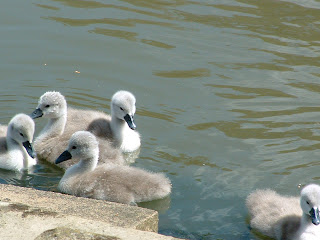
I fell in love... with a little family of swans. Once again, memories of Henry and Anne...

Although these two had far better luck with childbearing...