Showing posts with label Henry VIII. Show all posts

Thursday, January 6, 2011

On This Day in Tudor History


On January 6, 1540, King Henry VIII married Anna of Cleves. The marriage was never consummated, and she was not crowned queen consort.

Hans Holbein the Younger was dispatched to paint portraits of Anne and her younger sister, Amalia, both of whom Henry was considering as his fourth wife. Henry required the artist to be as accurate as possible, not to flatter the sisters. Sir Thomas Cromwell pushed for the union and oversaw the negotiations.

Henry valued education and cultural sophistication in women, but Anne lacked these. She could read and write, but only in German. Anne was dark haired, with a rather swarthy complexion, appeared solemn by English standards, and looked old for her age. Holbein painted her with high forehead, heavy-lidded eyes and a pointed chin.

Henry was not pleased with his fiancee, railing that she was nothing that was described to him and that he "Likes her not!"

Henry urged Cromwell to find a legal way to avoid the marriage but, by this point, doing so was impossible without endangering the vital alliance with the Germans. Despite Henry's very vocal misgivings, the two were married on January 6, 1540 at the royal Palace of Placentia in Greenwich, London by Archbishop Thomas Cranmer. The couple's first night as husband and wife was not a happy one. Henry confided to Cromwell that he had not consummated the marriage, saying, "I liked her before not well, but now I like her much worse".

Anna was commanded to leave the court on June 24th and the marriage was annulled on July 9, 1540 on the grounds of non-consummation and her pre-contract to Francis of Lorraine.

For not fighting the arrangement, Henry gave Anna a generous settlement which included the Palace at Richmond, Anne Boleyn's family home at Hever, and the title: "the King's Beloved Sister."

Tuesday, December 28, 2010

Cook Like a Tudor

Stuffed swans, blackbirds baked in a pie or roasted haunch of venison all would have had a place on Henry VIII's royal menu around this time of year, with special culinary variations for Christmas and New Year.

Now you can see exactly what the Tudors ate at the recently restored kitchens in Hampton Court Palace. The historic royal palace is offering free online cooking lessons, recipes, and historical tidbits about the 500-year-old cuisine.

Three of Henry’s favorite dishes are featured: ryschewys close and fryez (sweet and spicy Christmas dumplings), tarte owt of Lente (a rich cheese pie) and fylettys en galentyne (roast pork in caramelized onion gravy). Chef Robin Mitchener is the video guide to the Tudor palette.

If you're lucky enough to live in or be visiting London, Hampton Court Palace is offering in-person Tudor cooking demonstrations until Jan. 2. Visitors can watch chefs at work on the king’s Christmas feast. The demonstrations are included in the palace's general admission, which is about $24 per adult at the door.

Tons of Tudor Entertainment in 2011!

On the heels of the news that BBC America plans to air all four seasons of Showtime's "The Tudors" beginning January 2011, the BBC is also releasing their definitive Tudor collection on DVD in April.

(From the BBC press release)
"The Shadow of The Tower - BBC's Tudors Collection" combines the three most highly-praised, historically authentic mini-series ever produced about the great Tudor monarchs in one collectible set. From the heyday of BBC drama, these three tour-de-force dramas are meticulously researched and brilliantly acted, together winning 6 Emmy awards and 8 BAFTAs.

In The Shadow of the Tower, James Maxwell (The Portrait of a Lady) plays Henry VII, the first of the Tudor monarchs, who took over the throne after Richard III was killed at the Battle of Bosworth Field in 1485; Keith Michell received an Emmy and a BAFTA for his masterful portrayal of England's infamously fickle king in The Six Wives of Henry VIII; and double-Oscar winner Glenda Jackson turns in one of the most remarkable performances in television history, transforming herself into England's Virgin Queen in Elizabeth R. All 25 episodes of these three breathtaking dramas are included in this 12-disc collection, the definitive screen portrait of England's Tudor dynasty.

The BBC Tudors Collection comes out April 12th. Along with the three minis mentioned above, the set also includes "The Other Boleyn Girl" (BBC's version with Natascha McElhone). You can pre-order it on Amazon for $111.99.

Monday, December 27, 2010

Don't Have Showtime? You're in Luck!

I was JUST thinking last night that we should hear of The Tudors coming to cable TV channels soon. It has been almost a year since season 4 aired on Showtime and sure enough, I received this on my reader this morning:

'Tudors' Reign Again On BBC America: Net Acquires Basic-Cable Rights To Showtime's Period Drama

Henry VIII, or at least Jonathan Rhys-Meyers' portrayal of him, will return to TV as BBC America has acquired the basic-cable rights to the former Showtime original drama series.

BBC America scored the right to all four seasons of the Showtime series from CBS Television Distribution. Deal terms for the 38-episode series, which will bow on Jan. 16, were not disclosed. The Tudors concluded its original run on Showtime, with a pair of Emmy scepters in hand, last spring.

BBC America will begin its re-air reign with an all-day marathon of the series on Jan. 16, when it will air the first two seasons, beginning at 9 a.m. (ET/PT). From there, the network, proffering a first look at the show to non-premium TV subscribers, will air the remaining installments on Tuesdays at 10 p.m., starting on Jan. 18.

The Tudors, an Ireland Canada Co-Production, was a presentation of Showtime in association with Peace Arch Entertainment and Take 5 Productions.

Shot in Ireland and created by English screenwriter, Michael Hirst (Elizabeth, Camelot), The Tudors also stars Jeremy Northam (Gosford Park) as Thomas More, Henry Cavill (Tristan & Isolde) as Charles Brandon, and Natalie Dormer (Casanova) as Anne Boleyn, as it covers the political, prurient and marital turbulence that marked Henry VIII's nearly 40-year reign over England in the 16th century.

Thursday, December 23, 2010

The Tudors Christmas

Stuck at work in the US today I thought I'd share a favorite view of Tudor Christmas, courtesy of The Tudors on Showtime...

Thursday, December 16, 2010

On This Day in Tudor History

On December 16, 1485, Katherine of Aragon was born near Madrid, Spain.

Although I am an acknowledged fan of Katherine's nemesis, Anne Boleyn, I fondly view Katherine of Aragon as the matriarch of the Tudor Era. She certainly came to represent the first fully-educated female royal consort of the time and was, in her way, a true Renaissance woman. She would prove a ruthless regent in a time of war and, in my opinion, be Henry VIII's most formidable foe.

The youngest surviving child of King Ferdinand II of Aragon and Queen Isabella I of Castile, Katherine was quite short in stature with long, golden, auburn hair, wide blue eyes, a round face, and a fair complexion. She was descended, on her maternal side, from the English royal houses of John of Gaunt and Edward III.

At an early age, she was considered a suitable wife for Arthur, Prince of Wales, the eldest son of Henry VII of England and heir to the throne, due to her overwhelmingly prominent English ancestry inherited from her mother Queen Isabella I of Castile.

The couple met on November 4, 1501, at Dogmersfield in Hampshire and ten days later, they were married at St. Paul's Cathedral. A few months later, they both became ill, and Arthur died on April 2, 1502. Katherine recovered to find herself a widow.

Not wanting to return her dowry to her father, it was agreed she would marry Henry VII's second son, Henry, Duke of York, who was five years younger than she was. However, the death of her mother meant that Katherine's 'value' in the marriage market decreased and Henry VII kept procrastinating. She lived as a virtual prisoner at Durham House in London.

In order to marry Henry, Duke of York, they needed a dispensation from the pope. To obtain this, Katherine testified her marriage to Arthur was never consummated. This would later become the keystone in her fight to keep Henry from divorcing her to marry Anne Boleyn.

Katherine's second wedding took place on 11 June 1509, seven years after Prince Arthur's death, at Greenwich Church. She was 23 years of age. The new Henry VIII was just days short of his 18th birthday. They would be crowned together Sunday, June 24, 1509, by the Archbishop of Canterbury at a lavish ceremony at Westminster Abbey.

Of Katherine's six pregnancies, only Mary I, would live to adulthood to rule England.

After an (approximately) seven year battle to hold on to her marriage and remain Queen of England, Henry VIII had Archbishop Cranmer declare their union null and void and his marriage to Anne Boleyn valid. Katherine's daughter Mary was declared a bastard and removed from the succession.

Katherine died at Kimbolton Castle, on January 7, 1536, estranged from her husband and daughter. According to the chronicler Edward Hall, Anne Boleyn wore yellow for the mourning, which has been interpreted in various ways; Polydore Vergil interpreted this as an insult and celebration of her death. However, Imperial Ambassador Eustace Chapuys reported that it was actually King Henry who decked himself in yellow, celebrating the news and making a great show of his and Anne's daughter, Elizabeth, to his courtiers. This was seen as distasteful and vulgar.

Rumors circulated that Katherine had been poisoned, as Anne had threatened to murder both Katherine and Mary on several occasions. The rumors were born after the discovery of a black growth on Katherine's heart during her embalming. Modern medical experts are in agreement that this was likely to have been cancer, something which was not understood at the time.

On the day of Katherine's funeral, Anne Boleyn miscarried the son that probably would have been her savior, as Henry was already courting Jane Seymour and tired of Anne.

Katherine was buried in Peterborough Cathedral with the ceremony due to a Dowager Princess of Wales, not a queen. Henry did not attend the funeral and refused to allow Mary to attend.

Saturday, November 27, 2010

Bravo to the Rarely-Staged Henry VIII

My excitement and anticipation of seeing a production of Shakespeare's Henry VIII could easily have undermined my enjoyment of the actual play. Thankfully, the cast and crew at the Folger Theatre made that an impossibility.

I went to Southeast DC an hour early to peruse the Vivat Rex! exhibit at the Folger Shakespeare Library. This, I can report, was slightly disappointing after touring London and Kent last year. There were a few interesting pieces on display, but it was very small and limited and there was nothing as wonderful as what I saw at Hever, NPG, and Hampton Court Palace.

The play itself was staged in a very small, intimate room designed to (sort of) mimic the interior of Shakespeare's Globe. What set this apart from many of the plays I've seen was the stage design. It was so simple and yet so dramatic. Multiple metal screens with cut-outs, positioned in a zig-zag pattern along the sides of the stage, acted as halls of Tudor palaces, London alleys, prayer closets, and even the wings from which Henry would be haunted by those who he killed or let die.

The hanging, round chandelier doubled as a second stage above the primary action. The actors used the entire room and would walk through the audience or were staged among us to witness (such as the scene of Katherine and Henry's divorce hearing at Blackfriars').

The actors were wonderful and brought more emotion to Shakespeare's words than any I've seen before. Anthony Cochrane as Wolsey was excellent and Ian Merrill Peakes was a charismatic and attractive Henry VIII. Naomi Jacobson's changing accent was slightly distracting in her Queen Katherine. She seemed to teeter between English and Irish in an attempt to sound Spanish.

Although she had few lines, I loved Karen Peakes (Ian's real-life wife) as Anne Boleyn. Let's face it, in my mind she had huge shoes to fill. Peakes brought the perfect look and grace to Anne. She is now firmly the second best Anne I've ever seen, after Natalie Dormer.

The actor who stole the show was Louis Butelli as Henry's fool, Will Sommers. The director, Robert Richmond, chose Sommers as the portal through which the story would be told, he portrayed multiple characters, and brought out all of the humor Shakespeare is so famous for weaving through his plays. Every time he stepped out on stage, I knew something funny and interesting was about to happen.

Finally, I wanted to give props to Donna Langham Studio on the lovely costuming and Rodney Gordon, Ltd. for the well done millinery.

Thrilled and Excited!

It figures that I would pick a time and place other than 21st century America with which to be obsessed!

For the 500th anniversary of Henry VIII taking the throne, I spent two weeks exploring London and Kent and had the time of my life!

Because it is such a major undertaking for me to really explore Tudor England by visiting the places which intrigue me most, I am THRILLED when an exhibit opens in the US that allows me to partake in my passion for all things Tudor. And that is just what has come to the Folger Shakespeare Library.

The Library has brought the exhibit Vivat Rex! to Washington, DC in celebration of the 500th anniversary of Henry VIII's accession to the throne. This is the exhibit by the Grolier Club in NYC last year. (Ok, so we're a year late - who cares!?)

In addition, the Folger is running the Shakespeare play "Henry VIII" until November 28th. I am beyond excited to have tickets to the play today!!! It has garnered excellent reviews and I expect to be awed. Although the play closes soon, the Vivat Rex! exhibition runs until December 30th.
For tickets or more information, visit the Folger website.

I will promptly review the play and exhibition when I return home!

Saturday, November 20, 2010

Drawing the Tudors


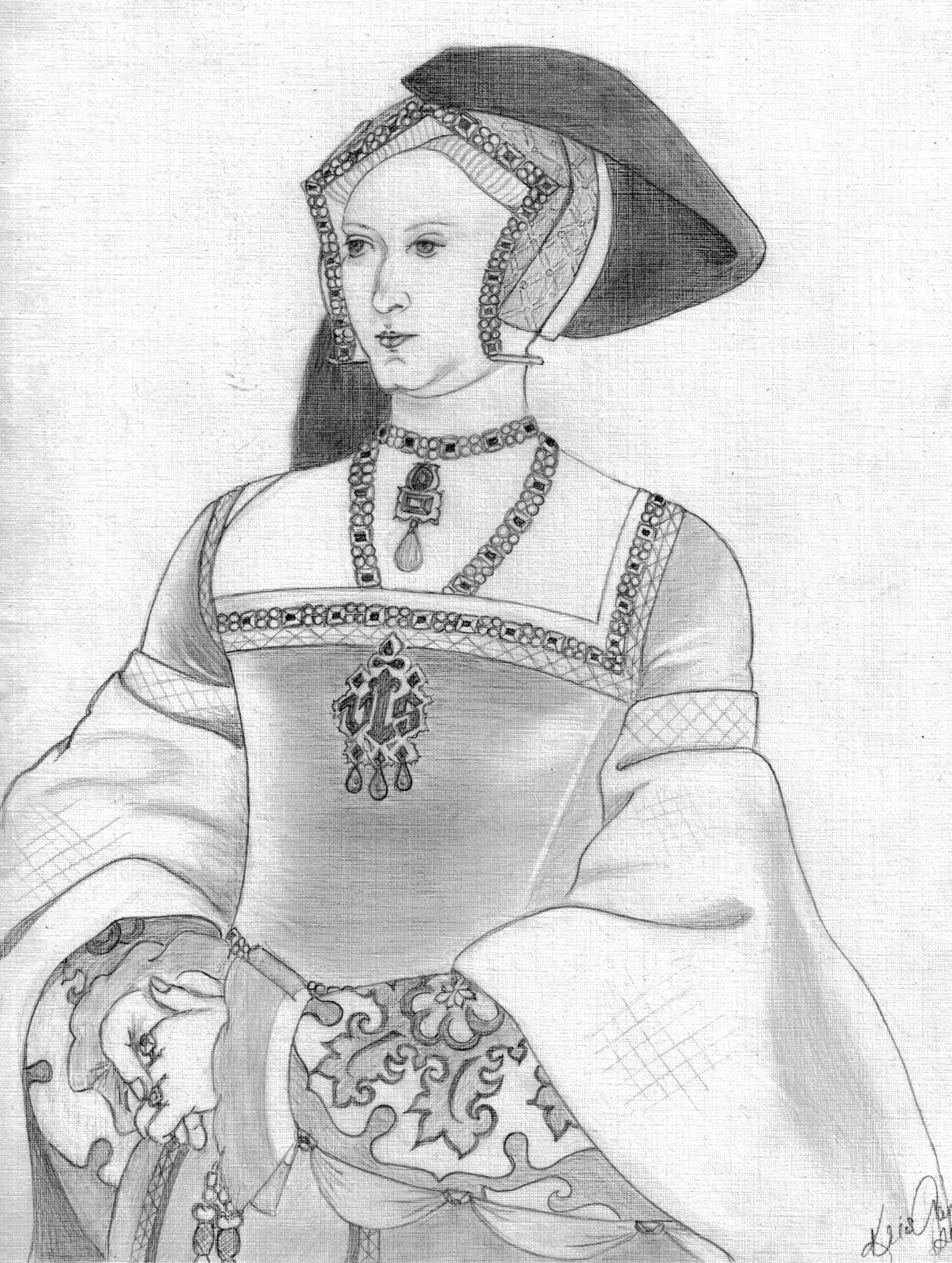
I posted my sketch of the most famous portrait of Anne Boleyn last week. This week, I give you Wife Number 3: Jane Seymour.
Jane was, in my opinion, the least attractive of Henry's wives. But I LOVED sketching her because her dress and jewels were so ornate and stunning. Let me know what you think!

Tuesday, November 16, 2010

The Kate & Wills Tudor Connection!


Paging through all the Prince William, Kate Middleton engagement coverage today, I stumbled upon an article that connects them to the Tudors!


I guess it shouldn't be that shocking considering the royal family is related to just about all the

royal families in European history. In fact, William and Kate are even related to each other. They are 12th cousins. Considerable separation for a royal couple.


The relative who connects the royal couple is actually a tyrant from the Elizabethan Era named Sir Thomas Leighton. According to the Daily Mail Online:

'In 1587 Leighton sailed to England to advise Sir Walter Raleigh on defence. In gratitude, the Queen gave him a knighthood, and her cousin Elizabeth Knollys' hand in marriage'


The article focuses on Leighton's terrible rule as governor of Guernsey, but take note of who he married: Elizabeth Knollys.

Elizabeth Knollys was the Queen's cousin, and a relation of Anne Boleyn through her sister. Elizabeth Knollys was the granddaughter of Mary Boleyn through her daughter, Catherine Carey. The other interesting thing is that Catherine Carey has, for many years, been the subject of speculation about her patern

ity. Catherine was conceived during the time that her mother, Mary, was Henry VIII's acknowledged mistress. Although the king never claimed paternity of Catherine or even her brother, Henry.


So, we know for sure that Kate and Wills are related to Anne Boleyn, but perhaps they are related to Henry VIII as well!


Below is the lineage of Kate and William back to the last Tudor monarch.

Monday, November 15, 2010

On This Day in Tudor History

On November 15, 1515, Thomas Wolsey was made a cardinal in the Catholic Church.
When Henry VIII became king of England in 1509, Wolsey became the King's almoner. Wolsey's affairs prospered and by 1514 he had become the controlling figure in virtually all matters of state and was extremely powerful within the church
Wolsey would become the King's chief advisor, enjoying great freedom and often depicted as an alter rex (other king). Within the church, he became Archbishop of
York , the second most important seat in England, and then was made a cardinal in 1515, giving him precedence over even the Archbishop of Canterbury.
Wolsey always aspired to be pope, but was passed over. His downfall was his inability to help Henry divorce Katherine of Aragon and marry Anne Boleyn. The Boleyns—Anne in particular—are usually credited with his political and personal demise.
His main legacy is from his interest in architecture, in particular his spectacular home, Hampton Court Palace (pictured), which still stands today.

Sunday, November 14, 2010

What REALLY Happened On This Day—November 14th—in Tudor History?

One of the more interesting claims to come out of the differing biographies and historical accounts of the Tudor Era is the possibility that Henry VIII and Anne Boleyn had more than one secret wedding ceremony and the anniversary of their ill-fated marriage is actually today, November 14, 1532.
Thanks to Elizabeth I's September 7, 1533 birthday, it's hard to dispute that Henry and Anne finally consummated their six-and-a-half-year relationship in November of 1532.
According to “The Life and Death of Anne Boleyn,” Boleyn biographer Eric Ives claims Henry and Anne thought that he was sufficiently detached from Katherine of Aragon to finally have sexual relations. After all, Henry just had taken Anne on the state visit to Calais to treat with King Francis I and even he officially received her as the King of England's consort--a major coup. There are also theories (as portrayed on Showtime's The Tudors) that Henry and Anne finally slept together when their return home was delayed by storms and they remained in Calais a few days.
The idea that a 16th century king desperate for a male heir would risk any resulting child being declared illegitimate is the likely impetus for the idea that Henry and Anne would marry--perhaps in secret--as quickly as possibly after the consummation. That would mean a November ceremony or perhaps just a traditional, formal betrothal.
By January, 1553, it's clear that Anne believed herself to be pregnant and it is widely believed the couple underwent a more formal secret ceremony in front of only their closest confidents on January 25 in the turret over the entrance gate to Whitehall Palace, London. In fact, the wedding was kept so quiet that Eric Ives quotes Eustace Chapuys, the Imperial ambassador, as reporting, in March 1533, rumors that Henry would not marry Anne until Easter of that year, clearly in the dark about any earlier wedding.
According to Ives's research, Tudor chronicler, Edward Hall, was the one who wrote of the possible November ceremony, putting forward St. Erkenwald's Day (November 14, 1532) as the date.
“The king, after his return [from Calais] married privily the Lady Anne Bulleyn on Saint Erkenwald’s Day, which marriage was kept so secret that very few knew it, till she was great with child, at Easter after.”
Of course, this date meant that Elizabeth was conceived in marriage. Had the wedding been January 25, Elizabeth would have been blatantly illegitimate by any standards. There would be no defense of her bastardy.
Even Catholic apologist and Boleyn hater, Nicholas Sander, dates Henry and Anne’s marriage as the 14th November.
All of this is fairly convincing evidence of two ceremonies.
Henry VIII loved nothing more than the masque. He loved to fool people and make them believe what he wanted them to believe. It is entirely possible that he would hold a secret wedding ceremony and dissemble in public.
However, the January ceremony baffles me a bit because Henry HAD to realize that the date would put paternity of his child (and long-awaited male heir, in HIS mind) and the legitimacy in question. They clearly had to real witnesses to a November ceremony and perhaps thought they needed another ceremony--with witnesses--to make it official before Anne started showing?
Then again, there seems to be no end to the things that baffle me (and millions of others) about Anne and Henry.

Saturday, October 23, 2010

On This Day in Tudor History:


On October 24, 1537, Jane Seymour, third wife of King Henry VIII, died. She died of puerperal fever less than two weeks after the birth of Henry's long-awaited only son.

Jane Seymour was the daughter of Sir John Seymour of Wiltshire and Margery Wentworth. Through her maternal grandfather, she was a descendant of King Edward III of England and the Percy family. Because of this, she and King Henry VIII were fifth cousins three times removed. She was also second cousin to her predecessor, Anne Boleyn, sharing a great-grandmother, Elizabeth Cheney. Her exact birth date is debated; usually given as 1509 but it has been noted that at her funeral, 29 women walked in succession. Since it was customary for the attendant company to mark every year of the deceased's life in numbers, this implies she was born in 1508.

She was not as highly educated as King Henry's previous wives, Catherine of Aragon and Anne Boleyn. She could read and write a little but was much better at needlework and household management. Jane's needlework was reported to be beautiful and elaborate; some of her work survived up to 1652, when it is recorded to have been given to the Seymour family.

She became a maid-of-honour in 1532 to Queen Catherine, but Jane may have served Catherine as early as 1527. Ironically, Jane went on to serve Queen Anne Boleyn.

Jane Seymour was noted to be pale, blonde and had blue eyes. It is said that she also had a turkey neck, the exact opposite of Anne Boleyn's dark hair and olive skin (and personality). According to Imperial Ambassador Eustace Chapuys, Jane was of middling stature and very pale; he also commented that she was not of much beauty. However, John Russell stated that Jane was "the fairest of all the King's wives." Polydore Vergil commented that she was "a woman of the utmost charm in both character and appearance."

The first report of Henry VIII's interest in Jane Seymour was in February 1536.

King Henry VIII was betrothed to Jane on the May 20, 1536, ONE day after Anne Boleyn's execution, and married her ten days later. She was publicly proclaimed as queen consort on June 4. She was never crowned, due to a plague in London where the coronation was to take place. Henry was also reluctant to crown Jane before she had fulfilled her duty as a queen consort by bearing him a son and a male heir.

In early 1537, Jane finally did just that. During her pregnancy, she developed a craving for quail, which Henry ordered for her from Calais and Flanders. She went into confinement in September 1537 and in October she gave birth to the coveted male heir, the future King Edward VI of England on October 12, 1537 at Hampton Court Palace.

After the christening, it had become clear that Jane Seymour was seriously ill. Her labor had been difficult, lasting two days and three nights, probably because the baby was not well positioned. Rumours circulated that she died following an emergency Caesarean section, after Henry ordered the baby to be cut from her to prevent a stillbirth, but caesarean births on live mothers were not possible at that time.

According to Edward's biographer, Jennifer Loach, Jane Seymour's death may have been due to an infection from a retained placenta. According to Allison Weir, death could have also been caused by puerperal fever due to a bacterial infection contracted during the birth or a tear in her perineum which became infected.

Jane Seymour died at Hampton Court.

Wednesday, October 13, 2010

On Sale Now: Henry VIII's final days on the throne


The fourth and final season of the amazing Showtime series The Tudors is on sale today.

This season saw the continuation of Henry's dalliance with young Catherine Howard and even his ill-advised marriage to the teenager. His discovery of her past and on-going indescretions, and of course, her beheading alongside Jane Rochford, that sneaky, strange harpy. We see Henry settle into old age with Kateryn Parr (Joely Richardson), gain a minimal amount of weight, see his BFF Charles Brandon age and die, and eventually walk into the sunset himself. (Michael Hirst opted out of showing his death)
Michael Hirst again takes some liberties with history, but nothing as unforgivable as one composite sister for Henry. (or season 3!)
Actually, I rather liked the imagined affair with Anne of Cleves and Mary's sweet first crush.

Now, I don't want anyone overseas to accidentally read a spoiler -- so I will warn you that you may want to skip the next sentence!
Of course, my favorite part of season four was the return of Henry's dead, put-upon wives! The ghosts of Katherine, Jane, and of course Anne were fantastic! I loved imagining Henry being haunted by Anne and seeing her in Elizabeth.

All-in-all, I couldn't possibly love it as much as seasons one and two, but season four was a pleasant way to wrap up the series and worth my Amazon pre-order.


- Posted using BlogPress from my iPad

On This Day in Tudor History

On October 12, 1537, Edward VI was born to Henry VIII and his third wife, Jane Seymour. Edward was the third monarch of the Tudor dynasty and England's first ruler who was raised as a Protestant.


Edward became King of England and Ireland on 28 January 1547 and was crowned on 20 February at the age of nine. The realm was governed by a Regency Council, because he never reached maturity. The Council was led by his uncle, Edward Seymour, 1st Duke of Somerset, and then by John Dudley, 1st Earl of Warwick, who later became Duke of Northumberland.


Edward's reign was marked by economic problems and social unrest that, in 1549, erupted into riot and rebellion. It was during Edward's reign that Protestantism was established for the first time in England with reforms that included the abolition of clerical celibacy, celebration of mass and other services in English. The architect of these reforms was Thomas Cranmer, Archbishop of Canterbury, whose Book of Common Prayer is still used today.

Edward fell ill in January 1553, and when he realized it was terminal, he and his Council drew up a "Devise for the Succession" to prevent the country being returned to Catholicism. Edward named his cousin, Lady Jane Grey, as his heir and excluded his half sisters, Mary and Elizabeth. However, this was disputed following Edward's death and Jane was only queen for nine days before Edward's half-sister, Mary, was proclaimed Queen. She proceeded to reverse many of Edward's Protestant reforms and turn England Catholic again.

Edward became ill in January 1553 with a fever and cough that gradually worsened. He made his final appearance in public on July 1, when he showed himself at his window in Greenwich Palace, horrifying those who saw him by his "thin and wasted" condition.

Edward died at the age of 15 at Greenwich Palace on July 6, 1553. He was buried in Henry VII Lady Chapel at Westminster Abbey on August 8, 1553, with reformed rites performed by Thomas Cranmer. At the same time, Queen Mary attended a mass for his soul in the Tower, where Jane Grey was, by then, a prisoner.

The cause of Edward VI's death is not certain. As with many royal deaths in the 16th century, rumours of poisoning abounded, but no evidence has been found to support these. The Duke of Northumberland, whose unpopularity was underlined by the events that followed Edward's death, was widely believed to have ordered the imagined poisoning. The surgeon who opened Edward's chest after his death found that "the disease whereof his majesty died was the disease of the lungs". The Venetian ambassador reported that Edward had died of consumption—in other words, tuberculosis—a diagnosis accepted by many historians.


- Posted using BlogPress from my iPad

Saturday, October 9, 2010

On This Day in Tudor History

On October 9, 1514, Mary Tudor--sister of King Henry VIII--married King Louis XII of France.


Known in her youth as one of the most beautiful princesses in Europe, Mary was betrothed in December 1507 to Charles of Castile, nephew of Katherine of Aragon -- twice Mary's sister-in-law. However, changes in the political alliances of the European powers meant this wedding did not take place. Instead, Cardinal Wolsey negotiated a peace treaty with France, and at the age of 18, Mary married its 52-year-old king at Abbeville. One of her Maids of Honour who attended her during life in France was Anne Boleyn.

Mary was described by the Venetian ambassador as "a paradise—tall, slender, grey-eyed, possessing an extreme pallor". She wore her glorious silken red-gold hair flowing loose to her waist. Despite two previous marriages, the king had no living sons and sought to produce an heir; but Louis died less than three months after he married Mary, rumored to be worn out by his exertions in the bedchamber. Their union produced no children.

Following Louis's death, the new King Francis I made attempts to arrange a second marriage for the beautiful widow. However, Mary had been unhappy with her marriage of state to Louis, and wanted to marry for love. She happened to be in love with her brother's best friend, Charles Brandon, 1st Duke of Suffolk.


Henry knew of his sister's feelings, but wanted any future marriage to be to his
advantage. When he sent Brandon to bring Mary back to England in late January 1515, he made the Duke promise that he would not propose to her. However, the couple married in secret in France on 3 March 1515. Technically this was treason, as Brandon had married a Royal Princess without Henry's consent. The King was outraged, and the Privy Council urged that Brandon should be imprisoned or executed. Because of the intervention of Cardinal Wolsey, and Henry's affection for both his sister and Brandon, the couple were let off with a heavy fine. They were officially married on 13 May 1515 at Greenwich Palace.

- Posted using BlogPress from my iPad

Wednesday, October 6, 2010

On This Day in Tudor History

On October 6, 1542, Sir Thomas Wyatt died at the home of a friend. Wyatt was a 16th-century English lyrical poet credited with introducing the sonnet into English.


Born at Allington Castle, near Maidstone in Kent, his father, Henry Wyatt, had been one of Henry VII's Privy Councillors and remained a trusted adviser when Henry VIII came to the throne in 1509. In his turn, Thomas Wyatt followed his father to court after his education at St John's College, Cambridge.

Wyatt was over six feet tall and reportedly, both handsome and physically strong. Wyatt was not only a poet, but also an ambassador in the service of Henry VIII. He first entered Henry's service in 1516 as 'Sewer Extraordinary', and the same year he began studying at St John's College of the University of Cambridge.

He married Elizabeth Brooke (1503–1560), in 1521, and a year later she gave birth to a son, Thomas Wyatt, the younger, who led Wyatt's rebellion many years after his father's death. In 1524 Henry VIII assigned Wyatt to be an Ambassador at home and abroad, and some time soon after, Wyatt separated from his wife on grounds of adultery.

He accompanied Sir John Russell to Rome to help petition Pope Clement VII to annul the marriage of Henry VIII to his first wife, Katherine of Aragon, an embassy whose goal was to make Henry free to marry Anne Boleyn. A fascinating mission if you believe, as I do, that Wyatt fell in love with Anne years before.

Many legends and conjectures have grown up around the notion that the young, unhappily married Wyatt fell in love with a young Anne Boleyn in the early-to-mid 1520s. His grandson (who penned a biography of Anne Boleyn many years after her death) wrote that the moment Thomas Wyatt had seen "this new beauty" on her return from France in winter 1522 he had fallen in love with her. According to various gossips they were lovers. Allegedly, Wyatt was Anne's suitor, even though he was married. When she attracted King Henry VIII's attentions sometime around 1525, Wyatt was the last of Anne's other suitors to be ousted by the king. According to Wyatt's grandson, after an argument over her during a game of bowls with the King, Wyatt was sent on, or himself requested, a diplomatic mission to Italy.

Wyatt's translation from Petrarch, "Whoso list to hunt," may refer to these early encounters with Anne Boleyn. Wyatt was at Calais when she and King Henry made their only foreign sojourn together (only a short time before they were married in secret). His poem "Sometime I fled the fire" may refer to this voyage.

In January 1533, Anne Boleyn is said to have told Wyatt, in front of other courtiers, that she had a 'furious hankering for apples' and that the King thought she might be pregnant. This was how the court discovered that Henry and Anne were already married. Wyatt would go on to serve as Chief Ewer (a distinguished serving role) at her Coronation. One poem of Wyatt's that certainly refers to Boleyn, after her demise, is "After great storms the calm returns;" its refrain, "the most happy," was one of her official mottoes.

In May 1536, Wyatt was imprisoned in the Tower of London along with five other men accused of committing adultery with Anne Boleyn -- including her brother.
Unlike the others, however, Wyatt was released from the Tower later that year, thanks to his friendship or his father's friendship with Thomas Cromwell, and he returned to his duties.

During his stay in the Tower he may have witnessed not only the execution of Anne Boleyn (May 19, 1536) from his cell window but also the executions of the five men.
Wyatt also wrote a poem inspired by the downfall and executions of all involved.

Wyatt fell ill and died in October 1542 around the age of 39, while staying with his friend Sir John Horsey at Clifton Maybank House in Dorset. He is buried in nearby Sherborne Abbey.

Descendants

Long after Thomas Wyatt's death, his only son, Thomas Wyatt the younger, led a thwarted rebellion against Henry's daughter, Queen Mary I, for which he was executed. The rebellion's aim was to set the Protestant-minded Elizabeth, the daughter of Anne Boleyn, on the throne. His sister Margaret Wyatt was the mother of Henry Lee of Ditchley, from whom descend the Lee's of Virginia, including Robert E. Lee. Thomas Wyatt's great grandson was Virginia Governor Francis Wyatt.

None of Wyatt's poems were published during his lifetime—the first book to feature his verse was printed fifteen years after his death.


WHOSO list to hunt ? I know where is an
hind !
But as for me, alas ! I may no more,
The vain travail hath wearied me so sore ;
I am of them that furthest come behind.
Yet may I by no means my wearied mind
Draw from the deer ; but as she fleeth afore
Fainting I follow ; I leave off therefore,
Since in a net I seek to hold the wind.
Who list her hunt, I put him out of doubt
As well as I, may spend his time in vain !
And graven with diamonds in letters plain,
There is written her fair neck round about ;
' Noli me tangere ; for Cæsar's I am,
And wild for to hold, though I seem tame.'


[Noli me tangere = "touch me not." ]


- Posted using BlogPress from my iPad

Wednesday, September 22, 2010

On This Day in Tudor History

On September 22, 1515, Anna von Jülich-Kleve-Berg was born in Germany. She is better known as Anne of Cleves, the fourth wife of Henry VIII of England and Queen of England from 6 January 1540 to 9 July 1540.


The marriage was never consummated, and she was never crowned queen consort. Following the annulment of their marriage, Anne was given a generous settlement by the king, and thereafter referred to as the "King's Beloved Sister."

Henry was convinced to make the match with Anne by his chancellor, Thomas Cromwell. It would prove to be Cromwell's undoing.

Anne's divorce settlement included Richmond Palace and Hever Castle -- home of Henry's former in-laws, the Boleyns. Her name and initials can still be seen throughout the house, such as on a fire screen in a sitting room.

Anne was invited to court often and had a close relationship with Henry's daughters, Mary and Elizabeth. In 1553, Anne was present at Mary I's coronation at Westminster. As the new Queen was a strict Catholic, Anne converted her religion for the second time, now becoming a Roman Catholic.

Anne's health began to fail in 1557, so Mary allowed her to live at Chelsea Old Manor, where Henry's widow Catherine Parr, lived after her remarriage. Here, in the middle of July 1557, Anne dictated her last will. In it, she mentions her brother, sister and sister-in-law, as well as the future Queen Elizabeth, the Duchess of Norfolk and the Countess of Arundel. She left money to her servants and asked Mary and Elizabeth to employ them in their households.

Anne died at Chelsea Old Manor on 16 July 1557, a few weeks before her forty-second birthday. The cause of her death was most likely cancer. She is buried in Westminster Abbey, on the opposite side of Edward the Confessor's shrine and slightly above eye level for a person of average height.

She is the only wife of Henry VIII to be buried in the Abbey and also has the distinction of being the last of Henry VIII's wives to die. She outlived Catherine Parr by 9 years.


- Posted using BlogPress from my iPad

Sunday, September 5, 2010

On This Day in Tudor History

On September 5, 1548, queen Catherine (Kateryn) Parr died of puerperal fever at the age of 35.

Following the death of King Henry VIII on 28 January 1547, Catherine was given an allowance of ₤7,000 per year, befitting her station. Henry had further ordered, after his death, though a queen dowager, she be given the respect of a Queen of England, as if he was still alive.

Catherine was able to marry her old love, Lord Seymour of Sudeley (Sir Thomas Seymour). As they married within six months of the old king's death, they had to obtain King Edward VI's permission for the match. When their union became public knowledge, it caused a small scandal. Catherine became pregnant by Seymour at age thirty-five. This pregnancy was a surprise as Catherine had not conceived a child during her first three marriages (however, two of her husbands had been much older than she).


Catherine gave birth to her only child — a daughter, Mary Seymour, named after her stepdaughter, Queen Mary I of England — on 30 August 1548, and died only six days later, on 5 September 1548, at Sudeley Castle in Gloucestershire, from what is thought to be puerperal fever or puerperal sepsis, also called childbed fever. Coincidentally, this was also the illness that killed Henry's third wife, Jane Seymour. It was not uncommon, due to the lack of hygiene around childbirth.

Catherine's widower, Lord Seymour of Sudeley, was beheaded for treason less than a year later, and the infant Mary was taken to live with the Dowager Duchess of Suffolk, a close friend of Catherine. After a year and a half, Mary's property was restored to her by an Act of Parliament, easing the burden of the infant's household on the duchess. The last recorded mention of Mary Seymour is on her second birthday, and although stories circulated that she eventually married and had children, most historians believe she died as a child.


- Posted using BlogPress from my iPad


Saturday, August 14, 2010

Fantastic LA Times Interview With Joan Bergin--Costume Designer for The Tudors

Emmy-nominated costume designer on dressing characters with success...

In recognition of the part clothes play, more than 75 outfits from contemporary shows, including some that are nominated this year for Emmys in costume design, are on display at the Fashion Institute of Design and Merchandising's museum and galleries in downtown Los Angeles. The free exhibit, which opened July 27 and runs through Sept. 4.


Joan Bergin, "The Tudors"

Bergin won Emmys for the series in 2007 and 2008 and received Irish Film & Television Academy awards in 2008 and 2009 as well. Her museum-quality costumes were featured in a Macy's display in New York City on St. Patrick's Day. Bergin has contributed to movies including "My Left Foot," "In the Name of the Father" and "The Prestige." She is currently working on the Starz Network production of "Camelot," starring Eva Green and Joseph Fiennes.

Image: How many costumes did you create for the show?

JB: I kind of lost count! My workshop was actually quite small, but across the series we made about 500 costumes and rented and modified countless others.... The amount of clothes — when I look at it now, I laugh. The relevant note is that I drape onto a form like old-style couture with a goodly degree of skill. Every detail, from cloth to braid to button. The workshop [staff] tease me.... I should just put [cloth, etc.] on the actors, pins and all, without having to make it up.

Image: Which character did you design the most for?

Bergin: Anne Boleyn. Showtime let the show take its natural course. For example, Anne came as a young girl who had studied a bit of the court but was no princess. I was able to slowly build her to become this magnificent creature.

Image: The characters don't physically age much as time progresses. The costumes are key in portraying this progression. How did you plan this out?

Bergin: I'm a great believer in research. Especially the social history around these people — it can be quite arrogant to make decisions for them. I figured, as Henry ransacked more and more churches and monasteries, he spent a lot of it on his own back and the clothes at court. I made them more opulent. As a character came more into the king's favor, they would dress better. Not unlike nowadays, as if someone were in a rising corporate position.

Image: What a sexy set! Which male and female character was your favorite to dress?

Bergin: Well, one of the things about Jonathan Rhys-Meyers [Henry] is that he is a natural clothes horse. He was very interested in the costumes. If he hadn't liked what I was doing it would have been agonizing. He really enjoyed the fittings and contributed. With women, it was Anne and Catherine Parr. We did magnificent jewelry for her [Anne's] coronation scene that cost an absolute fortune. We had a bodyguard on set!

Image: But both Henry Cavill [Charles Brandon] and Jonathan Rhys-Meyers are gorgeous. Did you have a favorite?


Bergin: Let's just say I always like things complex and difficult, and Henry [Rhys-Meyers] was more … complex.

Image: The jewelry was extraordinary. Did you create that?

Bergin: I have a lovely story — I got a letter from a company in Philadelphia called Sorrelli, huge fans of the show, who sent six pieces that were perfect for the costumes. The next two years they supplied "The Tudors" with most of the jewelry. They even have "The Tudors" collection on their website (www.sorrelli.com). There was also an Italian vendor, Autore, who lent us a $40,000 pearl necklace that was used for the decapitation of Anne.

Image: Is it true that you were inspired by modern clothing for the Tudor look?

Bergin: Yes. "The Tudors" is a strange blend of trying to be as authentic as possible but with a twist. I wanted people to look at it and say, "Look how sexy and foxy," rather than, "Oh! Who would wear that?" Balenciaga corsets and the Degas ballerinas inspired me. I also went to an auction and bought a trunk filled with fabrics collected by a woman from her travels all over the world. One of Catherine Parr's dresses was made with a 100-year-old obi.

Image: What was it like winning your first Emmy?

Bergin: "The Tudors" was a show I originally did not want to do because I didn't know how it could be done. I thought, "How on Earth could you do this?" And so when my name was called out, I was like one of those footballers and went, "Yes!" My friends claimed I knocked them down. I was shocked at how delighted I was. You often lack the security about what you're doing, and it was like being reaffirmed.