Saturday, November 20, 2010

Drawing the Tudors


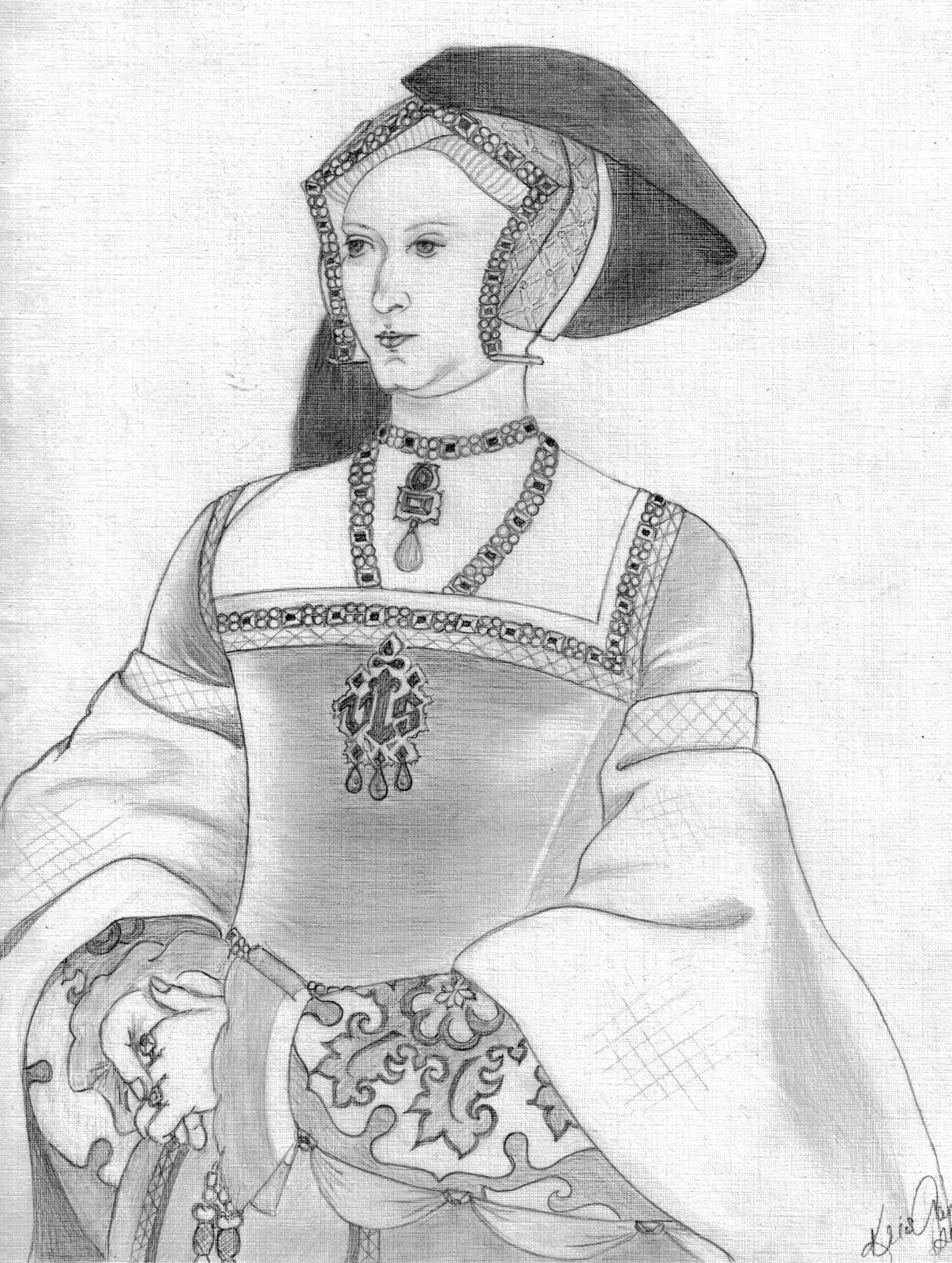
I posted my sketch of the most famous portrait of Anne Boleyn last week. This week, I give you Wife Number 3: Jane Seymour.
Jane was, in my opinion, the least attractive of Henry's wives. But I LOVED sketching her because her dress and jewels were so ornate and stunning. Let me know what you think!

Wednesday, November 17, 2010

On This Day in Tudor History


November 17, 1558 was monumental day in Tudor—and for that matter—English history.

It was on this day that Queen Mary I died at St. James Palace and her half sister, Elizabeth I, succeeded her to the throne, beginning the fashionable, creative, amazing Elizabethan Era in England. (think Shakespeare!)Against all odds, the daughter of Queen Anne Boleyn would become one of the greatest monarchs of all time.

Mary reigned only five years but left a legacy that would always be remembered as one of persecution and execution, leaving her with the sobriquet "Bloody Mary."

Elizabeth became queen at the age of 25, and upon hearing of her accession to the throne, she is reputed to have quoted the 118th Psalm's twenty-third line, in Latin: "A Dominum factum est illud, et est mirabile in oculis notris" - "It is the Lord's doing, and it is marvellous in our eyes."

Tuesday, November 16, 2010

The Kate & Wills Tudor Connection!


Paging through all the Prince William, Kate Middleton engagement coverage today, I stumbled upon an article that connects them to the Tudors!


I guess it shouldn't be that shocking considering the royal family is related to just about all the

royal families in European history. In fact, William and Kate are even related to each other. They are 12th cousins. Considerable separation for a royal couple.


The relative who connects the royal couple is actually a tyrant from the Elizabethan Era named Sir Thomas Leighton. According to the Daily Mail Online:

'In 1587 Leighton sailed to England to advise Sir Walter Raleigh on defence. In gratitude, the Queen gave him a knighthood, and her cousin Elizabeth Knollys' hand in marriage'


The article focuses on Leighton's terrible rule as governor of Guernsey, but take note of who he married: Elizabeth Knollys.

Elizabeth Knollys was the Queen's cousin, and a relation of Anne Boleyn through her sister. Elizabeth Knollys was the granddaughter of Mary Boleyn through her daughter, Catherine Carey. The other interesting thing is that Catherine Carey has, for many years, been the subject of speculation about her patern

ity. Catherine was conceived during the time that her mother, Mary, was Henry VIII's acknowledged mistress. Although the king never claimed paternity of Catherine or even her brother, Henry.


So, we know for sure that Kate and Wills are related to Anne Boleyn, but perhaps they are related to Henry VIII as well!


Below is the lineage of Kate and William back to the last Tudor monarch.

Another Generation of Girls Will Dream of Marrying a Prince and Want This Ring

I clearly remember waking at 4 in the morning Eastern Time to watch the royal wedding of Prince Charles to Lady Diana Spencer. I joined the many little girls dreaming of finding her prince, being dressed in a fairy tale gown, and marrying in grand style. I even bought a replica of Diana's spectacular sapphire and diamond engagement ring, when I was old enough to afford it.

Today, as William and Kate posed for reporters, photographers, and retold the story of their engagement--just as his parents did before--Kate showed-off that very same sapphire and diamond ring that Diana wore in 1981.

According to the BBC:

William has given Kate his mother's ring. He said:

"It's very special to me. As Kate's very special to me now, it was right to put the two together."

Speaking as they stood arm-in-arm before photographers, Prince William said giving Kate his mother Diana's distinctive sapphire and diamond engagement ring was "my way of making sure my mother didn't miss out on today and the excitement".

The couple will marry in the year that would have been William's parents' 30th anniversary.

A Piece of Modern History

Taking a break from 16th century history for a moment to report modern history being made. The moment we've been waiting for has arrived: Another royal wedding!

The Prince of Wales is delighted to announce the engagement of Prince William to Miss Catherine Middleton.
The wedding will take place in the Spring or Summer of 2011, in London. Further details about the wedding day will be announced in due course.
Prince William and Miss Middleton became engaged in October during a private holiday in Kenya. Prince William has informed The Queen and other close members of his family. Prince William has also sought the permission of Miss Middleton’s father.

Following the marriage, the couple will live in north Wales, where Prince William will continue to serve with the Royal Air Force.

Monday, November 15, 2010

On This Day in Tudor History

On November 15, 1515, Thomas Wolsey was made a cardinal in the Catholic Church.
When Henry VIII became king of England in 1509, Wolsey became the King's almoner. Wolsey's affairs prospered and by 1514 he had become the controlling figure in virtually all matters of state and was extremely powerful within the church
Wolsey would become the King's chief advisor, enjoying great freedom and often depicted as an alter rex (other king). Within the church, he became Archbishop of
York , the second most important seat in England, and then was made a cardinal in 1515, giving him precedence over even the Archbishop of Canterbury.
Wolsey always aspired to be pope, but was passed over. His downfall was his inability to help Henry divorce Katherine of Aragon and marry Anne Boleyn. The Boleyns—Anne in particular—are usually credited with his political and personal demise.
His main legacy is from his interest in architecture, in particular his spectacular home, Hampton Court Palace (pictured), which still stands today.

Sunday, November 14, 2010

What REALLY Happened On This Day—November 14th—in Tudor History?

One of the more interesting claims to come out of the differing biographies and historical accounts of the Tudor Era is the possibility that Henry VIII and Anne Boleyn had more than one secret wedding ceremony and the anniversary of their ill-fated marriage is actually today, November 14, 1532.
Thanks to Elizabeth I's September 7, 1533 birthday, it's hard to dispute that Henry and Anne finally consummated their six-and-a-half-year relationship in November of 1532.
According to “The Life and Death of Anne Boleyn,” Boleyn biographer Eric Ives claims Henry and Anne thought that he was sufficiently detached from Katherine of Aragon to finally have sexual relations. After all, Henry just had taken Anne on the state visit to Calais to treat with King Francis I and even he officially received her as the King of England's consort--a major coup. There are also theories (as portrayed on Showtime's The Tudors) that Henry and Anne finally slept together when their return home was delayed by storms and they remained in Calais a few days.
The idea that a 16th century king desperate for a male heir would risk any resulting child being declared illegitimate is the likely impetus for the idea that Henry and Anne would marry--perhaps in secret--as quickly as possibly after the consummation. That would mean a November ceremony or perhaps just a traditional, formal betrothal.
By January, 1553, it's clear that Anne believed herself to be pregnant and it is widely believed the couple underwent a more formal secret ceremony in front of only their closest confidents on January 25 in the turret over the entrance gate to Whitehall Palace, London. In fact, the wedding was kept so quiet that Eric Ives quotes Eustace Chapuys, the Imperial ambassador, as reporting, in March 1533, rumors that Henry would not marry Anne until Easter of that year, clearly in the dark about any earlier wedding.
According to Ives's research, Tudor chronicler, Edward Hall, was the one who wrote of the possible November ceremony, putting forward St. Erkenwald's Day (November 14, 1532) as the date.
“The king, after his return [from Calais] married privily the Lady Anne Bulleyn on Saint Erkenwald’s Day, which marriage was kept so secret that very few knew it, till she was great with child, at Easter after.”
Of course, this date meant that Elizabeth was conceived in marriage. Had the wedding been January 25, Elizabeth would have been blatantly illegitimate by any standards. There would be no defense of her bastardy.
Even Catholic apologist and Boleyn hater, Nicholas Sander, dates Henry and Anne’s marriage as the 14th November.
All of this is fairly convincing evidence of two ceremonies.
Henry VIII loved nothing more than the masque. He loved to fool people and make them believe what he wanted them to believe. It is entirely possible that he would hold a secret wedding ceremony and dissemble in public.
However, the January ceremony baffles me a bit because Henry HAD to realize that the date would put paternity of his child (and long-awaited male heir, in HIS mind) and the legitimacy in question. They clearly had to real witnesses to a November ceremony and perhaps thought they needed another ceremony--with witnesses--to make it official before Anne started showing?
Then again, there seems to be no end to the things that baffle me (and millions of others) about Anne and Henry.