Sunday, November 14, 2010

What REALLY Happened On This Day—November 14th—in Tudor History?

One of the more interesting claims to come out of the differing biographies and historical accounts of the Tudor Era is the possibility that Henry VIII and Anne Boleyn had more than one secret wedding ceremony and the anniversary of their ill-fated marriage is actually today, November 14, 1532.
Thanks to Elizabeth I's September 7, 1533 birthday, it's hard to dispute that Henry and Anne finally consummated their six-and-a-half-year relationship in November of 1532.
According to “The Life and Death of Anne Boleyn,” Boleyn biographer Eric Ives claims Henry and Anne thought that he was sufficiently detached from Katherine of Aragon to finally have sexual relations. After all, Henry just had taken Anne on the state visit to Calais to treat with King Francis I and even he officially received her as the King of England's consort--a major coup. There are also theories (as portrayed on Showtime's The Tudors) that Henry and Anne finally slept together when their return home was delayed by storms and they remained in Calais a few days.
The idea that a 16th century king desperate for a male heir would risk any resulting child being declared illegitimate is the likely impetus for the idea that Henry and Anne would marry--perhaps in secret--as quickly as possibly after the consummation. That would mean a November ceremony or perhaps just a traditional, formal betrothal.
By January, 1553, it's clear that Anne believed herself to be pregnant and it is widely believed the couple underwent a more formal secret ceremony in front of only their closest confidents on January 25 in the turret over the entrance gate to Whitehall Palace, London. In fact, the wedding was kept so quiet that Eric Ives quotes Eustace Chapuys, the Imperial ambassador, as reporting, in March 1533, rumors that Henry would not marry Anne until Easter of that year, clearly in the dark about any earlier wedding.
According to Ives's research, Tudor chronicler, Edward Hall, was the one who wrote of the possible November ceremony, putting forward St. Erkenwald's Day (November 14, 1532) as the date.
“The king, after his return [from Calais] married privily the Lady Anne Bulleyn on Saint Erkenwald’s Day, which marriage was kept so secret that very few knew it, till she was great with child, at Easter after.”
Of course, this date meant that Elizabeth was conceived in marriage. Had the wedding been January 25, Elizabeth would have been blatantly illegitimate by any standards. There would be no defense of her bastardy.
Even Catholic apologist and Boleyn hater, Nicholas Sander, dates Henry and Anne’s marriage as the 14th November.
All of this is fairly convincing evidence of two ceremonies.
Henry VIII loved nothing more than the masque. He loved to fool people and make them believe what he wanted them to believe. It is entirely possible that he would hold a secret wedding ceremony and dissemble in public.
However, the January ceremony baffles me a bit because Henry HAD to realize that the date would put paternity of his child (and long-awaited male heir, in HIS mind) and the legitimacy in question. They clearly had to real witnesses to a November ceremony and perhaps thought they needed another ceremony--with witnesses--to make it official before Anne started showing?
Then again, there seems to be no end to the things that baffle me (and millions of others) about Anne and Henry.

Thursday, November 11, 2010

Drawing the Tudors

Last year when I was unemployed and going to school I also started sketching again. I hadn't tried to sketch, draw, or paint anything in years and wasn't sure I could do it. But I was so inspired by the beautiful paintings, rich clothing, and fabulous jewels of the Tudor era that it was either sketch or dress-up in costume every day.

Since corsets, gowns, and French hoods are just not practical, I began reproducing some of Holbein (and others') most famous paintings. I'd posted one back in December -- my take on Anne Boleyn.


More to follow in the coming months.

On This Day in Tudor History

On November 12, 1555, Stephen Gardiner, Bishop of Winchester and long-time servant of three Tudor monarchs, died at the (approximate) age of 62.

Gardiner was an English Roman Catholic bishop and politician during the English Reformation period who served as Lord Chancellor during the reign of Queen Mary I of England.

Interestingly, Gardiner *may* have been a blood relation of Queen Mary I. His father is known to have been Sir William Gardner, a substantial cloth merchant of the town where he was born. His mother, Helen, was reputed to be an illegitimate daughter of Jasper Tudor, 1st Duke of Bedford.

Gardiner's abilities attracted the notice of Cardinal Thomas Wolsey, who made him his secretary. In 1527 he and Sir Thomas More were named commissioners of England in arranging a treaty with the French ambassadors for the support of an army in Italy against Charles V, Holy Roman Emperor.

That year he accompanied Wolsey on his important diplomatic mission to France. Henry VIII was, at this time, anxious to cement his alliance with King Francis I, and gain support for his plans to divorce Katherine of Aragon. In the course of his progress through France, Wolsey received orders from Henry to send back his secretary, Gardiner, for fresh instructions. Wolsey was obliged to reply that he positively could not spare Gardiner as he was the only instrument he had in advancing the king's "Great Matter." The next year, Wolsey sent Gardiner and Edward Foxe, provost of King's College, Cambridge, to Italy to promote the same business with the pope. Pope Clement VII, who had been recently imprisoned in Castel Sant'Angelo by mutinous soldiers of the Holy Roman Empire, had managed to escape to Orvieto and was fearful of offending Charles V. Clement refused to issue a definitive ruling concerning Henry's annulment.

Gardiner's pleading was unsuccessful and he returned home where Wolsey and the pope's legate, Cardinal Campeggio, began the infamous trial at Black Friars.

Under King Edward VI, he completely opposed the policy of the dominant party both in ecclesiastical and in civil matters. Of course he objected to the religious changes in England, both on principle and on the ground of their being moved during the king's minority. His remonstrances resulted in his being imprisoned in the Fleet, and the visitation of his diocese was held during his imprisonment. Though soon released, he was soon called before the council, and, refusing to give them satisfaction on some points, was thrown into the Tower of London, where he remained for the rest of the reign, a period of over five years.

On Queen Mary I's entry into London, Gardiner and other Catholics were set free. Gardiner was restored to his Bishopric and appointed Lord Chancellor, and he placed the crown on the queen's head at her coronation. He also opened her first parliament and for some time was her leading councillor. He was now also called upon, in old age, to undo not a little of the work in which he had been instrumental in his earlier years — to demonstrate the legitimacy of the queen's birth and the legality of her mother's marriage, to restore the old religion, and to recant his own words touching the royal supremacy.

As chancellor he had the onerous task of negotiating the queen's marriage treaty with Philip II of Spain, for which he shared a general repugnance. Shortly after this, he became ill and died quickly. He lies buried in his own cathedral at Winchester, where his effigy is still to be seen.

Gardiner is played by Terence Rigby in the 1998 film Elizabeth, where he is portrayed as a villainous bishop who took part in the Ridolfi plot and who vehemently opposed Elizabeth I's Act of Uniformity. For the record: this is quite inaccurate, as Gardiner had died before Elizabeth ascended the throne.

Wednesday, November 10, 2010

The Tudors' Jewelry Maker on Ideeli


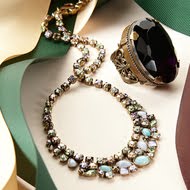
The jewelry maker who replicated some of the jewelry from the Showtime series The Tudors for retail (and I believe even made some pieces used on the show) is a featured brand this week on Ideeli. Sorelli has quite a few pieces that work with modern fashion and with your Renaissance/Tudor-centric costumes.

For those who don't know, Ideeli is a pretty cool little online sale site that keeps things fresh by only selling a small lot from a particular brand for a very limited time. They sell out VERY quickly... so if interested, I suggest going there now!

Check it out at www.ideeli.com

The Sorelli pieces just went on sale this morning (Nov. 10, Eastern Standard Time, USA).

Saturday, October 23, 2010

On This Day in Tudor History:


On October 24, 1537, Jane Seymour, third wife of King Henry VIII, died. She died of puerperal fever less than two weeks after the birth of Henry's long-awaited only son.

Jane Seymour was the daughter of Sir John Seymour of Wiltshire and Margery Wentworth. Through her maternal grandfather, she was a descendant of King Edward III of England and the Percy family. Because of this, she and King Henry VIII were fifth cousins three times removed. She was also second cousin to her predecessor, Anne Boleyn, sharing a great-grandmother, Elizabeth Cheney. Her exact birth date is debated; usually given as 1509 but it has been noted that at her funeral, 29 women walked in succession. Since it was customary for the attendant company to mark every year of the deceased's life in numbers, this implies she was born in 1508.

She was not as highly educated as King Henry's previous wives, Catherine of Aragon and Anne Boleyn. She could read and write a little but was much better at needlework and household management. Jane's needlework was reported to be beautiful and elaborate; some of her work survived up to 1652, when it is recorded to have been given to the Seymour family.

She became a maid-of-honour in 1532 to Queen Catherine, but Jane may have served Catherine as early as 1527. Ironically, Jane went on to serve Queen Anne Boleyn.

Jane Seymour was noted to be pale, blonde and had blue eyes. It is said that she also had a turkey neck, the exact opposite of Anne Boleyn's dark hair and olive skin (and personality). According to Imperial Ambassador Eustace Chapuys, Jane was of middling stature and very pale; he also commented that she was not of much beauty. However, John Russell stated that Jane was "the fairest of all the King's wives." Polydore Vergil commented that she was "a woman of the utmost charm in both character and appearance."

The first report of Henry VIII's interest in Jane Seymour was in February 1536.

King Henry VIII was betrothed to Jane on the May 20, 1536, ONE day after Anne Boleyn's execution, and married her ten days later. She was publicly proclaimed as queen consort on June 4. She was never crowned, due to a plague in London where the coronation was to take place. Henry was also reluctant to crown Jane before she had fulfilled her duty as a queen consort by bearing him a son and a male heir.

In early 1537, Jane finally did just that. During her pregnancy, she developed a craving for quail, which Henry ordered for her from Calais and Flanders. She went into confinement in September 1537 and in October she gave birth to the coveted male heir, the future King Edward VI of England on October 12, 1537 at Hampton Court Palace.

After the christening, it had become clear that Jane Seymour was seriously ill. Her labor had been difficult, lasting two days and three nights, probably because the baby was not well positioned. Rumours circulated that she died following an emergency Caesarean section, after Henry ordered the baby to be cut from her to prevent a stillbirth, but caesarean births on live mothers were not possible at that time.

According to Edward's biographer, Jennifer Loach, Jane Seymour's death may have been due to an infection from a retained placenta. According to Allison Weir, death could have also been caused by puerperal fever due to a bacterial infection contracted during the birth or a tear in her perineum which became infected.

Jane Seymour died at Hampton Court.

Saturday, October 16, 2010

On This Day in Tudor History

On October 16, 1555, under Queen Mary I, Hugh Latimer and Nicholas Ridley were burned at the stake he was burnt at the stake, becoming one of the three Oxford Martyrs of Anglicanism and the U.S. Episcopal Church.
Latimer was a Fellow of Clare College, Cambridge, Bishop of Worcester before the Reformation, and later chaplain to Henry VIII's son, King Edward VI. He also served as chaplain to Katherine Duchess of Suffolk until Edward VI's sister, Mary I, came to the throne, he was tried for his beliefs and teachings in Oxford and imprisoned. Ridley was also an English Bishop of London who was tried for his teachings and his support of Lady Jane Grey.

They were both burned at the stake outside Balliol College, Oxford.

The deaths of Latimer, Ridley and later Thomas Cranmer — now known as the Oxford Martyrs — are commemorated in Oxford by the Victorian Martyrs' Memorial which is located near the actual execution site. The Latimer room in Clare College, Cambridge is named after him.

Friday, October 15, 2010

Something New...

Trying some new looks for my blog. I'm teaching myself Adobe Illustrator and experimenting with some designs I've had in my head.

If you don't mind, please take a moment and let me know what you think of the headers (the title of the blog) as they change.

The one above is the first new style.

Thanks for your help and for stopping by!